Looking for Vegetable and Fruit Harvest Dates: Approximate number of days from Planting in 2026? Scroll down this page and follow the links. And if you bring home some fruit or vegetables and want to can, freeze, make jam, salsa or pickles, see this page for simple, reliable, illustrated canning, freezing or preserving directions. There are plenty of other related resources, click on the resources dropdown above. If you are having a hard time finding canning lids, I've used these, and they're a great price & ship in 2 days.
If you have questions or feedback, please let me know! There are affiliate links on this page. Read our disclosure policy to learn more.
Vegetable and Fruit Harvest Dates: Approximate number of days from Planting
Vegetable and Fruit Harvest Dates: Approximate number of days from Planting
Approximate number of days from planting to market
maturity under optimum growing conditions.
-----------------------------------------------------------------
Crop                    Early Variety  Common Type  Late Variety
-----------------------------------------------------------------
Bean, bush                   46            ---           65
Bean, pole                   56            ---           72
Bean, lima, bush             65            ---           78
Beet                         50            ---           80
Broccoli, sprouting1         70            ---          150
Brussels sprouts2            90            ---          100
Cabbage2                     62            ---          110
Carrot                       60            ---           85
Cauliflower, snowball type2  55            ---           65
Chinese cabbage              70            ---           80
Chives                      ---             90          ---
Corn                         70            ---          100
Cucumber                     60            ---           70
Eggplant                     70            ---           85
Kohlrabi                     55            ---           65
Lettuce, head                60            ---           85
Lettuce, leaf                40            ---           50
Melon, Honey Ball           ---            105          ---
Melon, Honey Dew            ---            115          ---
Muskmelon                    75             83           90
Mustard                      40            ---           60
Okra                         50            ---           60
Onion                        85            ---          120
Parsley                      70            ---           85
Parsnip                     100            ---          130
Pea                          58            ---           77
Pepper, sweet2               60            ---           80
Potato                       90            ---          120
Pumpkin                     110            ---          120
Radish                       22            ---           40
Radish, winter type          50            ---           60
Rutabaga                    ---             90          ---
Spinach                      40            ---           50
Squash, winter               50            ---           68
Squash, summer               80            ---          120
Tomato2                      65            ---          100
Turnip                       40            ---           75
Watermelon                   65             75           95
-----------------------------------------------------------------
When these crops are planted under low-temperature conditions, it
takes them longer than indicated above to reach the harvest stage.
-----------------------------------------------------------------
1 For a direct-seeded
crop. Transplanting may delay maturity by a few weeks, depending on
environmental conditions.
2 For a transplanted crop additional time is needed from seed sowing
to transplanting.
Yields per acre of vegetable crops
The average yields for the whole country are lower than are desirable for profitable production. The indicated good yields can be exceeded readily in some areas where really favorable conditions exist. In fact in some states the average yield equals or exceeds what would be considered a good yield in other vegetable-growing areas.
----------------------------------------------------------------------------------
                    Approximate Average Yield
Crop                per Acre for United States      Good Yield per Acre
----------------------------------------------------------------------------------
Asparagus           90 crates (30 lb.)              200 crates
Bean, market        110 bushels                     200 bushels
Bean, lima, market  80 bushels, in pods (32 lb.)    150 bushels
Bean, market        200 bushels (52 lb.)            400 bushels or 1,400 bunches
Broccoli            120 crates (42 lb.)             200 crates
Brussel sprouts     4.5 tons                        5 tons
Cabbage, market     8 tons                          12 tons
Carrot, bunched     360 crates (75 lb.)             450 crates
Cauliflower         420 crates (37 lb.)             600 crates
Chard, Swiss        ---                             5 tons
Corn, market        105 crates (5 dozen, 50 lb.)    300 crates (1,500 dozen)
Cucumbers, market   155 bushels (48 lb.)            500 bushels
Eggplant            300 bushels (33 lb.)            500 bushels
Garlic              4,800 lbs.                      5,600 lb.
Lettuce             360 cartons (2 dozen)           600 cartons
Melon, Honey Ball   120 crates (70 lb.)             200 crates
Melon, Honey Dew    310 crates (70 lb.)             400 crates
Muskmelon           110 crates (70 lb.)             200 crates
Okra                ---                             5 tons
Onion               360 sacks (50 lb.)              700 sacks
Pea, market         105 bushels, in pods (30 lb.)   150 bushels
Pepper, bell        245 bushels (25 lb.)            500 bushels
Potato, early       200 bushels (60 lb.)            400 bushels
Potato, late        250 bushels (60 lb.)            400 bushels
Pumpkin             ---                             50 tons
Radish              ---                             20,000 bunches
Rhubarb             ---                             2 tons
Rutabaga            ---                             10 tons
Spinach, market     250 bunches (25 lb.)            500 bushels
Squash, summer      ---                             400 bushels (45 lb.)
Squash, winter      ---                             10 tons
Tomato, market      150 bushels (56 lb.)            300 bushels
Turnip              ---                             5 tons, bunched
Watermelon          280 fruits (about 25 lb. each)  500 fruits
----------------------------------------------------------------------------------
----------------------------------------------------------------------------------
Temperature requirements
The temperature requirements for holding vegetables in storage or transit, the average freezing points, and the suggested relative humidities.1
-----------------------------------------------------------------------
                      Recommended     Recommended     Maximum Amount of
Vegetables            Temperature  Relative Humidity   Time to be Held
-----------------------------------------------------------------------
                         ( F)            (%)              (Weeks)
Asparagus                 32            90-95               1-2
Bean                    45-50           85-90               1-2
Bean, lima, unshelled     32            90-95                2
Beet, topped3             32            90-95               7-8
Broccoli                  32            90-95               1-2
Brussels sprouts          32            90-95                4
Cabbage                   32            90-95              12-16
Carrot, topped3           32            90-95              16-20
Cauliflower               32            90-95               3-4
Chinese cabbage4          32            90-95               8-12
Corn                      32            90-95                -1
Cucumber                50-55           90-95               2-4
Eggplant                50-55           85-90               1-2
Greens and Salads5        32            90-95
Kohlrabi                  32            90-95               4-8
Lettuce, head             32            90-95               2-4
Melon
  Casaba                50-55           85-90               4-8
  Crenshaw and Persian  45-50           85-90               1-2
  Honey Dew             50-55           85-90               2-4
Muskmelon               45-50           85-90               1-2
Okra                    45-50           85-90               1-2
Onion, dry                32            70-75                28
Parsnip, topped3          32            90-95              24-26
Pea                       32            85-90               1-2
Pepper, sweet           45-50           85-90               1-2
Potato6                 38-40           85-90              24-26
Pumpkin                 50-55           70-75              12-26
Radish, spring, bunched   32            90-95               1-2
Radish, winter            32            90-95               8-16
Rhubarb                   32            90-95               1-2
Rutabaga, topped3         32            90-95               8-16
Spinach                   32            90-95               1-2
Squash, summer          45-50           85-95                -1
Squash, winter7         50-55           70-75              24-26
Tomato, mature green    55-60           85-90               1-2
Tomato, ripe            45-55           85-90               1-2
Turnip, topped3           32            90-95              16-22
Watermelon              50-55           85-90               1-4
-----------------------------------------------------------------------
-----------------------------------------------------------------------
1 Based on U.S.D.A. Handbook 66,1954.
2 The ranges in the relative humidity of the storage room are offered only as a guide. The effectiveness of these on the water loss from the products will depend on temperature, air movement, method of stacking, and the type of packaging, including liners, icing, and wrapping.
3 When root crops are marketed in bunches with tops attached, the holding temperatures should be the same as those indicated for the topped product, but the holding period can be only 10 to 14 days (or less).
4 Early cabbage can be held in good condition for ¾ to 11/2 months.
5 Chard, collar, dandelion, green onions, leaf lettuce, mustard, parsley, turnip tops, and watercress. The storage life varies with the green but is at best only about a week.
6 Potatoes held for chipping should be at 50° to 60°F. Those stored below 50°F will need to be at higher temperatures before chipping.
7 Winter squash should be cured prior to storage, to provide a protection against disease organisms during storage. To cure, hold for 10 days with artificial heat at 80-85°F with a RH of 80%.
Sources:
Handbook for Vegetable Grower, Revised Printing by James Edward Knott, Professor of Vegetable Crops, University of California at Davis. Published by John Wiley and Sons, Somerset, NJ 08873.
Fruit and Vegetable Facts and Pointers. United Fresh Fruit and Vegetable Association, 101919th Street, N.W., Washington, D.C. 20036.
- Local Meat, Milk and Eggs
- Farm markets and roadside stands
- Fun Factory Tours
- Pumpkin patches
- Corn mazes
- Children's consignment sales
- Local Honey Finder
- Venues: Farms, Wineries, Orchards for your event, wedding or party
- Easter egg hunts
- Fruit and vegetable festivals
- Winery tours and wine tastings
- Horse rides, stables, lessons, trails
- Maple Syrup farms and sugarworks
- Bed and Breakfasts on Farms, Wineries, Ranches and Orchards
- Zombie Paintball venues
- Christmas Tree Farms and lots
- Environmental resources
- Consumer fraud information
- Wholesale food sources
- Resources for Farmers
Canning Books, Supplies and Accessories
These are my favorite essential canning tools, books and supplies. I've been using many of these for over 50 years of canning! The ones below on this page are just the sampling of. my preferred tools. but you can find much more detailed and extensive selections on the pages that are linked below.
- Vacuum Foodsealers for freezing, dried foods, and refrigerated foods - the FoodSaver line
- Selecting a KitchenAid mixer and attachments for home canning
- Steam Juicers
- Strainers, pit removers, seed-skin-stem removers, jelly strainers, etc. All types, makes and prices (from $19 to $350)
- Cherry pitters reviews, prices and ordering
- Food dehydrators - easy and fast to dry your own fruits, veggies, sun-dried tomatoes, etc.
The All New Ball Book Of Canning And Preserving: Over 350 of the Best Canned, Jammed, Pickled, and Preserved Recipes Paperback
This is THE book on canning! My grandmother used this book when I was a child.; It tells you in simple instructions how to can almost anything; complete with recipes for jam, jellies, pickles, sauces, canning vegetables, meats, etc.
If it can be canned, this book likely tells you how! Click on the link below for more information and / or to buy (no obligation to buy)The New Ball Blue Book of Canning and Preserving
Canning and Preserving for Dummies by Karen Ward
This is another popular canning book. Click here for more information, reviews, prices for Canning and Preserving For Dummies
Of course, you do not need to buy ANY canning book as I have about 500 canning, freezing, dehydrating and more recipes all online for free, just see Easy Home Canning Directions.
Home Canning Kits
Ball Enamel Water Bath Canners:

I have several canners, and my favorite is the stainless steel one at right. It is easy to clean and seems like it will last forever. Mine is 10 years old and looks like new.
The black ones are the same type of standard canner that my grandmother used to make everything from applesauce to jams and jellies to tomato and spaghetti sauce.
This complete kit includes everything you need and lasts for years: the canner, jar rack, Jar grabber tongs, lid lifting wand, a plastic funnel, labels, bubble freer, It's much cheaper than buying the items separately. It's only missing the bible of canning, the Ball Blue Book.
You will never need anything else except jars & lids (and the jars are reusable)!
The complete list of canners is on these pages:
- Water bath canners - Good for acidic foods, like applesauce, pickles, salsa, jams, jellies, most fruits
- Pressure canners - needed for low and non-acidic foods, like canned vegetables (corn, green beans, etc), and meats
- Canners for glass top stoves if you have a glass or ceramic stove
- Canners for induction stovetops

Pressure Canners
If you plan on canning non-acidic foods and low acid foods that are not pickled - this means: meats, seafood, soups, green beans corn, most vegetables, etc., then you ABSOLUTELY must use a Pressure Canner.
Of course, you can use a pressure canner as a water bath canner as well - just don't seal it up, so it does not pressurize. This means a Pressure Canner is a 2-in-1 device. With it, you can can almost ANYTHING.
There are also other supplies, accessories, tools and more canners, of different styles, makes and prices, click here!
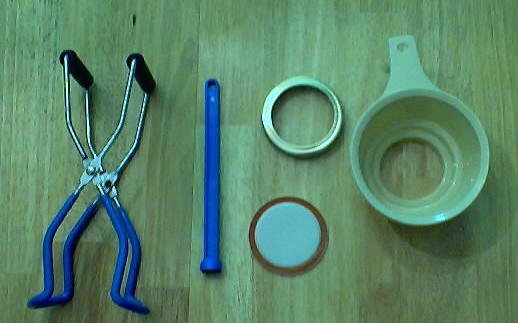
Basic Canning Accessories
From left to right:
- Jar lifting tongs to pick up hot jars
- Lid sanitizer / lifter - to remove lids from the pot of boiling water (sterilizing )
- Lids- disposable - you may only use them once
- Ring - holds the lids on the jar until after the jars cool - then you remove them, save them and reuse them
- Canning Jar funnel - to fill the jars
FREE Illustrated Canning, Freezing, Jam Instructions and Recipes
Don't spend money on books. that you don't need to. Almost everything you can find in some book sold online or in a store is on my website here for free. Start with theEasy Home Canning Directions below. That is a master list of canning directions which are all based upon the Ball Bblue book, the National Center for Home Food Preservation and other reputable lab tested recipes. Almost every recipe I present in addition to being lab tested com. is in a step by step format with photos for each step and complete. explanations. that tell you how to do it, where to get the supplies and pretty much everything you need to know. In addition, there almost always in a PDF format so you can print them out and use them while you cook.
[ Easy Home Canning Directions]
[FAQs - Answers to common questions and problems]
[Recommended books about home canning, jam making, drying and preserving!]


Looking for canning equipment and supplies?
Water bath canner with a jar rack
Pressure canners for gas, electric and induction stoves: Presto 23Qt or T-fal 22Qt
 Canning scoop (this one is PERFECT)
 Ball Blue book (most recent version)
Jars: 8oz canning jars for jams

Want to start your own Podcast, Blog, Vlog, etc? This
GoPro kit has EVERYTHING you need:
all accessories
Find Other types of farms:
Farm markets and roadside stands
Road trips and camping resources
Local Honey, apiaries, beekeepers
Consumer fraud and scams information
Home canning supplies at the best prices on the internet!
Maple Syrup Farms, sugarworks, maple syrup festivals
Environmental information and resources
Farms For Your Event for birthday parties, weddings, receptions, business meetings, retreats, etc.
Festivals - local fruit and vegetable festivals
Get the
most recent version of
the Ball Blue Book
Canning and preserving, making jams, salsa, sauces, pickles, etc is SO easy with our step by step directions! Just about all you need is a canner and canning jars!
