
Looking for Home-canning Seafood Soups and Chowders- Easily! in 2026? Scroll down this page and follow the links. And if you bring home some fruit or vegetables and want to can, freeze, make jam, salsa or pickles, see this page for simple, reliable, illustrated canning, freezing or preserving directions. There are plenty of other related resources, click on the resources dropdown above. If you are having a hard time finding canning lids, I've used these, and they're a great price & ship in 2 days.
If you have questions or feedback, please let me know! There are affiliate links on this page. Read our disclosure policy to learn more.
Home-canning Seafood Soups and Chowders- Easily!
How to Make Home-canned Seafood Soups, Bisques and Chowders
Click here for a PDF print version (coming soon!)
Making and canning your own Seafood Soups and Chowders is easy. You can make a New England clam chowder or Manhattan clam chowder, a crab bisque, fish soup, etc. You can make them organic, gluten-free, low salt, low fat; whatever meets your own preferences! And better tasting than any store-bought, chock-full-of-chemicals can of soup!Well provide 2 examples below, New England clam chowder or Manhattan clam chowder, but this same process works for seafood.
Just scroll down this page to see how to do it, in easy steps and completely illustrated. The only special equipment you need is a Pressure Canner and canning jars with new lids. Caution: Do not add noodles or other pasta, rice, flour, cream, milk or other thickening agents to home canned soups. And if dried beans or peas are used, they must be fully rehydrated first. If you want to can stews and other soups that contain chunks of meat, rather than just the broth, see this page. Also see this page for how to can tomato soup or tomato-basil soup
Ingredients
- Fish, clams, crab, lobster, scallops, etc. - any quantity - You can use your own recipe, or the clam chowder examples in step 1
- Vegetables - any type, any mix, any quantity
- Broth liquid - Vegetable broth, tomato juice or simply water - your choice
- Seasonings: yes, you can add herbs like salt, pepper, thyme, rosemary, oregano, basil, etc.
- Caution: Do not add noodles or other pasta, rice, flour, cream, milk or other thickening agents to home canned soups. And if dried beans or peas are used, they must be fully rehydrated first.
Equipment
- Jar funnel ($5 at Target, other big box stores, and often grocery stores; and available online - see this page) or order it as part of the kit with the Jar grabber .
- Jar grabber (to pick up the hot jars)- Big box stores and grocery stores sometimes carry them; and it is available online - see this page. It's a tremendously useful to put jars in the canner and take the hot jars out (without scalding yourself!). The kit sold below has everything you need, and at a pretty good price:
- At least 1 large pot; I prefer 16 to 20 quart Nonstick ceramic coated pots for easy cleanup.
- Large spoons and ladles,
- 1 Pressure Canner (a large pressure pot with a lifting rack to sanitize the jars after filling (about $75 to $200 at mall kitchen stores and "big box" stores, but it is cheaper online; see this page for more information). For low acid foods (most vegetables, you can't use an open water bath canner, it has to be a Pressure Canner to get the high temperatures to kill the bacteria. If you plan on canning every year, they're worth the investment.- and it helps support this web site!
- Half pint canning jars (Grocery stores, like Publix, Kroger, Safeway carry them, as do some big box stores - about $7 per dozen 8 ounce jars including the lids and rings)
- Lids - thin, flat, round metal lids with a gum binder that seals them against the top of the jar. They may only be used once.
- Rings - metal bands that secure the lids to the jars. They may be reused many times.
- Lid lifter (has a magnet to pick the lids out of the almost-boiling water where you sanitize them. ($4 at big box stores or it comes in the kit at left)
Optional stuff:
Directions to Can Seafood Soups and Chowderss
Step 1 - Collect and wash your ingredients
Select, wash, and prepare vegetables as appropriate for each type; generally just washing under running cool water.
This is pretty generic recipe, testede by the NCHFP for for canning any combination of seafoods and vegetables including any vegetables, dried beans or peas, red meats, poultry, or seafood, with any exceptions and notes added..
Example New England Clam Chowder recipe, it makes about 10 pint jars:
(NOTE: you do NOT add any milk or other dairy - this is the base. You add 2 cups of milk and 2 tablespoons of butter to each pint at the time you open, heat and serve the base. Home canning dairy products is considered unsafe and dangerous.)
- 1/2 lb salt pork
- 1 cup chopped onion
- 3 to 4 quarts of clams, as prepared in step 2. Clams vary a lot, so it is hard to say how many fresh whole live clams you'd need to have 3 or 4 lbs of prepared clams, for me, it was about 20 lbs.
- 2 quarts of diced potatoes (and 1/2 inch sized cubes.
- 2 quarts of boiling water
- 1 teaspoon salt (optional)
- 1 teaspoon ground pepper
Example for Manhattan Clam Chowder, makes about 10 pint jars:
- 1/2 lb salt pork
- 1 cup chopped onion
- 3 to 4 quarts of clams, as prepared in step 2. Clams vary a lot, so it is hard to say how many fresh whole live clams you'd need to have 3 or 4 lbs of prepared clams, for me, it was about 20 lbs.
- 2 quarts of diced potatoes (and 1/2 inch sized cubes.
- 2 quarts of boiling water
- 2 cups of chopped tomatoes
- 1/2 cup chopped celery (finely diced, it takes baout 1 large stalk)
- 1/2 bay leaf
- 1/2 teaspoon thyme
- 1 teaspoon salt (optional)
- 1 teaspoon ground pepper
Step 2 - Prepare the seafood
Example: preparing clams: Keep clams live on ice until ready to can. Scrub shells thoroughly and rinse, steam 5 minutes, and open. Remove clam meat. Collect and save the clam juice. Wash clam meat in water containing 1 teaspoon of salt per quart. Rinse and cover clam meat with boiling water containing 2 tablespoons of lemon juice or 1/2 teaspoon of citric acid per gallon. Boil 2 minutes and drain. To make minced clams, grind clams with a meat grinder or food processor.
Example: preparing crab: Keep live crabs on ice until ready to can. Wash crabs thoroughly, using several changes of cold water. Simmer crabs 20 minutes in water containing 1/4 cup of lemon juice and 2 tablespoons of salt (or up to 1 cup of salt, if desired) per gallon. Cool in cold water, drain, remove back shell, then remove meat from body and claws. Soak meat 2 minutes in cold water containing 2 cups of lemon juice or 4 cups of white vinegar, and 2 tablespoons of salt (or up to 1 cup of salt, if desired) per gallon. Drain and squeeze meat to remove excess moisture.
Example preparing fish: Typical fish used are Blue, Mackerel, Salmon, Steelhead, Trout, Tillapia, Catfishand other Fatty Fish Except Tuna. Remove head, tail, fins, and scales. Wash and remove all blood. Split fish lengthwise, if desired. Cut cleaned fish into 3-1/2 inch lengths. Caution: Eviscerate fish within 2 hours after they are caught. Keep cleaned fish on ice until ready to can. Note: Glass-like crystals of magnesium ammonium phosphate sometimes form in canned salmon. There is no way for the home canner to prevent these crystals from forming, but they usually dissolve when heated and are safe to eat.
Prepare any other meats: Like the salt pork; clean and chop into small 1/2 inch sized pieces.
Step 3 - Wash the jars and lids
 Now's a good time to get the jars ready, so you won't be rushed later. The dishwasher is fine for the jars; especially if it has a "sanitize" cycle, the water bath processing will sanitize them as well as the contents! If you don't have a dishwasher with a sanitize cycle, you can wash the containers in hot, soapy water and rinse, then sanitize the jars by boiling them 10 minutes, and keep the jars in hot water until they are used.
NOTE: If a canning recipe calls for 10 minutes or more of process time in the canner (as this one does), then the jars do not need to be "sanitized" before filling them. But really, sanitizing them first is just good hygeine and common sense! See this page for more detail about cleaning and sanitizing jars and lids.
Put the lids into a pan of hot, but not quite boiling water (that's what the manufacturer's recommend) for 10 minutes, and use the magnetic "lid lifter wand" to pull them out. Leave the jars in the dishwasher on "heated dry" until you are ready to use them. Keeping them hot will prevent the jars from breaking when you fill them with the hot jam.
Step 4 - Brown the non-seafood meats
If you are including any non-seafood meats, like the salt pork; brown it in a pan with 1 tablespoon of vegetable oil. Then drain the oil off and discard the oil.
Step 5 - Combine all of the ingredients and simmer
Add the all the ingredients (seafood, meats, boiling water, vegetables and seasonings - but no dairy) and simmer until soft for about 15 minutes. If you are adding any dried beans or peas, prepare the dried beans and dried peas separately first: For each cup of dried beans or peas, add 3 cups of water, boil 2 minutes, remove from heat, soak 1 hour, and heat to boil; drain. then add to the others and cook.
Step 6 - Get the lids warming in hot (but not boiling) water
 Lids: put the lids into a pan of hot water for at least several minutes; to soften up the gummed surface and clean the lids.

Need lids, rings and replacement jars?
Get them all here, delivered direct to your home, at the best prices on the internet!
Step 7 - Boil the soup (carrying on from step 5) for 5 more minutes
Boil the combined mix for 5 minutes. Caution: Do not thicken with any starch, flour or other thickeners.
Salt to taste, if desired.
Step 8 - Fill the jars and put the lid and rings on
Fill jars halfway with the solid mixture (the bottom of the pan). Add remaining liquid, leaving 1-inch headspace. . Then put the filled jars into the canner!
This is where the jar tongs come in really handy!
Step 9 - Let the canner vent steam for 10 minutes
Put the heat on high and let the steam escape through the vent for 10 minutes to purge the airspace inside the canner.
Step 10 - Put the weight on and let the pressure build
After 10 minutes of venting, put the weight on and close any openings to allow the pressure to build to 11 pounds.
Step 11 - Process the jars in the pressure canner (NOT a standard water bath canner)
Once the gauge hits 10 pounds, start your timer going - for the time in the charts below. Adjust the heat, as needed, to maintain 10 - 14 pounds of pressure, again, as appropriate for your type of canner
Note: the charts below will help you determine the right processing time and pressure, if you have a different type of canner, or are above sea level.
Adjust lids and process following the recommendations below according to the method of pressure canner you have.
The times are the longer seafood processing times recommneded by both the NCHFP and the Ball Blue Book 2018 edition.
Recommended process time for Seafood Soups and Chowderss | ||||
| Canner Pressure (PSI) at Altitudes of | ||||
| Style of Pack | Jar Size | Process Time | 0 - 1,000 ft | Above 1,000 ft |
| Hot | Pints | 100* min | 10 lb | 15 lb |
| Quarts | 115* | 10 | 15 | |
| . | ||||
Recommended process time for Seafood Soups and Chowderss | ||||||
| Canner Pressure (PSI) at Altitudes | ||||||
| Style of Pack | Jar Size | Process Time | 0 - 2,000 ft | 2,001 - 4,000 ft | 4,001 - 6,000 ft | 6,001 - 8,000 ft |
| Hot | Pints | 100* min | 11 lb | 12 lb | 13 lb | 14 lb |
| Quarts | 115* | 11 | 12 | 13 | 14 | |
Note: This document was adapted from the "Complete Guide to Home Canning," Agriculture Information Bulletin No. 539, USDA, revised 2009 and Reviewed November 2009 and the Ball Blue Book (
It is important to learn how to operate your pressure canner by reading the owner's manual that came with your particular canner. If you cannot find your owner's manual, you can obtain find one online: Here is where to find some common manufacturer's manuals:
or by contacting the company that made your canner. Give the model number to the manufacturer, and they will send you the right manual. Click here for more information about pressure canners and a variety of models you can order.
Step 12 - Turn off the heat and let it cool down
When the processing time from the chart above is up, turn off the heat, and allow the pressure canner to cool and the pressure to drop to zero before opening the canner. Let the jars cool without being jostled. After the pressure drops to zero (usually, you can tell but the "click" sound of the safety release vents opening, as well as but the gauge. Let the pressure in the canner drop to zero by itself. This may take 45 minutes in a 16-quart canner filled with jars and almost an hour in a 22-quart canner. If the vent is opened before the pressure drops to zero OR if the cooling is rushed by running cold water over the canner, liquid will be lost from the jars. Too rapid cooling causes loss of liquid in the jars!
Step 13 - Remove the jars
Lift the jars out of the water and let them cool on a wooden cutting board or a towel, without touching or bumping them in a draft-free place (usually takes overnight), here they won't be bumped. You can then remove the rings if you like, but if you leave them on, at least loosen them quite a bit, so they don't rust in place due to trapped moisture. Once the jars are cool, you can check that they are sealed verifying that the lid has been sucked down. Just press in the center, gently, with your finger. If it pops up and down (often making a popping sound), it is not sealed. If you put the jar in the refrigerator right away, you can still use it. Some people replace the lid and reprocess the jar, then that's a bit iffy. If you heat the contents back up, re-jar them (with a new lid) and the full time in the canner, it's usually ok. You're done!
Once cooled, they're ready to store. I find they last with really good quality up to 12 months. But after that, they get darker in color. They still are safe to eat, but the flavor and texture aren't as good, so if you're a prepper, just keep them in a cool dark place and check them periodically for leakage). So eat them in the first 68 to 12 months after you prepare them!
Can't find the equipment? We ship to all 50 states!
Use our Feedback form!
FAQs - Answers to Common Questions
As my jars are cooling after i take them out of the canner, they sometimes make a popping or hissing noise. Is this normal and safe?
Yes, the lids are designed to flex and that's actually a key selling point. You can tell if a jar hasn't sealed properly (after it has cooled completely) if the lid flexes and makes a popping sound when you press the center of the lid with your finger. The popping sounds while it is cooling is the lid being sucked down by the vacuum that is forming inside the jar - which a normal part of the sealing process. Hissing sounds are usually just escaping steam or hot water evaporating on hot surfaces, also normal!
Canning Books, Supplies and Accessories
These are my favorite essential canning tools, books and supplies. I've been using many of these for over 50 years of canning! The ones below on this page are just the sampling of. my preferred tools. but you can find much more detailed and extensive selections on the pages that are linked below.
- Vacuum Foodsealers for freezing, dried foods, and refrigerated foods - the FoodSaver line
- Selecting a KitchenAid mixer and attachments for home canning
- Steam Juicers
- Strainers, pit removers, seed-skin-stem removers, jelly strainers, etc. All types, makes and prices (from $19 to $350)
- Cherry pitters reviews, prices and ordering
- Food dehydrators - easy and fast to dry your own fruits, veggies, sun-dried tomatoes, etc.
The All New Ball Book Of Canning And Preserving: Over 350 of the Best Canned, Jammed, Pickled, and Preserved Recipes Paperback
This is THE book on canning! My grandmother used this book when I was a child.; It tells you in simple instructions how to can almost anything; complete with recipes for jam, jellies, pickles, sauces, canning vegetables, meats, etc.
If it can be canned, this book likely tells you how! Click on the link below for more information and / or to buy (no obligation to buy)The New Ball Blue Book of Canning and Preserving
Canning and Preserving for Dummies by Karen Ward
This is another popular canning book. Click here for more information, reviews, prices for Canning and Preserving For Dummies
Of course, you do not need to buy ANY canning book as I have about 500 canning, freezing, dehydrating and more recipes all online for free, just see Easy Home Canning Directions.
Home Canning Kits
Ball Enamel Water Bath Canners:

I have several canners, and my favorite is the stainless steel one at right. It is easy to clean and seems like it will last forever. Mine is 10 years old and looks like new.
The black ones are the same type of standard canner that my grandmother used to make everything from applesauce to jams and jellies to tomato and spaghetti sauce.
This complete kit includes everything you need and lasts for years: the canner, jar rack, Jar grabber tongs, lid lifting wand, a plastic funnel, labels, bubble freer, It's much cheaper than buying the items separately. It's only missing the bible of canning, the Ball Blue Book.
You will never need anything else except jars & lids (and the jars are reusable)!
The complete list of canners is on these pages:
- Water bath canners - Good for acidic foods, like applesauce, pickles, salsa, jams, jellies, most fruits
- Pressure canners - needed for low and non-acidic foods, like canned vegetables (corn, green beans, etc), and meats
- Canners for glass top stoves if you have a glass or ceramic stove
- Canners for induction stovetops

Pressure Canners
If you plan on canning non-acidic foods and low acid foods that are not pickled - this means: meats, seafood, soups, green beans corn, most vegetables, etc., then you ABSOLUTELY must use a Pressure Canner.
Of course, you can use a pressure canner as a water bath canner as well - just don't seal it up, so it does not pressurize. This means a Pressure Canner is a 2-in-1 device. With it, you can can almost ANYTHING.
There are also other supplies, accessories, tools and more canners, of different styles, makes and prices, click here!
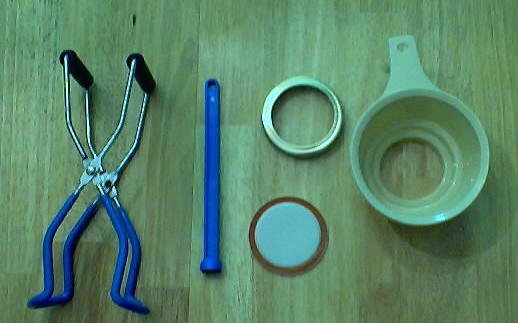
Basic Canning Accessories
From left to right:
- Jar lifting tongs to pick up hot jars
- Lid sanitizer / lifter - to remove lids from the pot of boiling water (sterilizing )
- Lids- disposable - you may only use them once
- Ring - holds the lids on the jar until after the jars cool - then you remove them, save them and reuse them
- Canning Jar funnel - to fill the jars
FREE Illustrated Canning, Freezing, Jam Instructions and Recipes
Don't spend money on books. that you don't need to. Almost everything you can find in some book sold online or in a store is on my website here for free. Start with theEasy Home Canning Directions below. That is a master list of canning directions which are all based upon the Ball Bblue book, the National Center for Home Food Preservation and other reputable lab tested recipes. Almost every recipe I present in addition to being lab tested com. is in a step by step format with photos for each step and complete. explanations. that tell you how to do it, where to get the supplies and pretty much everything you need to know. In addition, there almost always in a PDF format so you can print them out and use them while you cook.
[ Easy Home Canning Directions]
[FAQs - Answers to common questions and problems]
[Recommended books about home canning, jam making, drying and preserving!]


Looking for canning equipment and supplies?
Water bath canner with a jar rack
Pressure canners for gas, electric and induction stoves: Presto 23Qt or T-fal 22Qt
 Canning scoop (this one is PERFECT)
 Ball Blue book (most recent version)
Jars: 8oz canning jars for jams

Want to start your own Podcast, Blog, Vlog, etc? This
GoPro kit has EVERYTHING you need:
all accessories
Find Other types of farms:
Farm markets and roadside stands
Road trips and camping resources
Local Honey, apiaries, beekeepers
Consumer fraud and scams information
Home canning supplies at the best prices on the internet!
Maple Syrup Farms, sugarworks, maple syrup festivals
Environmental information and resources
Farms For Your Event for birthday parties, weddings, receptions, business meetings, retreats, etc.
Festivals - local fruit and vegetable festivals
Get the
most recent version of
the Ball Blue Book
Canning and preserving, making jams, salsa, sauces, pickles, etc is SO easy with our step by step directions! Just about all you need is a canner and canning jars!
