
>How Long Can You Store Fruit and Vegetables? Fresh, Frozen, Canned or Refrigerated?
How Long Will Fruits and Vegetables Keep:
On the shelf, in the fridge, canned or frozen?
Click here for a PDF print version
With the cost of food as high as it is, and to preserve the taste and nutritional benefit of vegetables and fruits, it is important to know how long food will keep its taste, texture and nutritional value using the available storage methods at home: the refrigerator, freezer, on the counter or canned. The table below lists the estimated storage life, for best quality, for various fruits, vegetables and products from these for each of the home storage methods. Canned and frozen fruit, vegetables and products may be safe beyond these dates if their packaging is intact and the temperatures were maintained; but they are likely to show degradation in text, appearance and texture.
This chart assumes that you started with ripe, but not over fruit fruit and vegetables that were not bruised, moldy, cut open or otherwise damaged. See the explanation at the bottom of the page, following the chart for more details of assumed storage conditions.
| Fruit or vegetable | Form | Optimal storage temperature (and other conditions, if applicable | Optimal humidity | Storage Life | Comments | ||||||
|
F |
C | At optimal storage temperature and humidity | At room temperature on the counter |
Basement, or other cool, dark storage area (40 - 65 F) |
Refrigerated (35 - 40 F) |
Frozen (0 F) |
Canned (commercial or properly home canned) |
||||
| Apples | fresh | 30-40 | -1-4 | 90-95 | 1-12 months | 1 week | 3 weeks | 1 year | 1 year | Chill sensitive stored at 35-40 F (2-4 C) | |
| applesauce | canned | 40 - 60 | not applicable |
|
2 weeks | 18 months | 2 years | ||||
| apple butter | canned | not applicable | 6 weeks | 2 years | 5 years | ||||||
| apple jelly | canned | not applicable | 6 weeks | not suitable | 1 year | ||||||
| Apricots | fresh | 31-32 | -1-0 | 90-95 | 1-3 weeks | ||||||
| Apricot jam | |||||||||||
| Apricots | fresh | 31-32 | -1-0 | 90-95 | 1-3 weeks | ||||||
| Artichokes | fresh | 32-35 | 0-2 | 90-95 | |||||||
| Artichokes, Jerusalem | fresh | 31-32 | 0-2 | 90-95 | 4-5 months | ||||||
| Asparagus | fresh | 32-35 | 95-100 | 2-3 weeks | |||||||
| Avocados, ripe | fresh | 38-45 | 3-7 | 85-95 | |||||||
| Avocados, unripe | fresh | 45-50 | 7-10 | 85-95 | Keep away from ethylene producing fruits | ||||||
| Bananas, green | fresh | 62-70 | 17-21 | 85-95 | |||||||
| Bananas, ripe | fresh | 56-60 | 13-16 | 85-95 | |||||||
| Basil | fresh | 52-59 | 11-15 | 90-95 | |||||||
| Beans, dry | fresh | 40-50 | 40-50 | 6-10 months | |||||||
| Beans, green or snap | fresh | 40-45 | 95 | 7-10 days | |||||||
| Beans, sprouts | fresh | 32 | 0 | 95-100 | 7-9 days | ||||||
| Beans. Lima | fresh | 37-41 | 0 | 95 | 5-7 days | ||||||
| Beets | fresh | 32-35 | 0-2 | 90-95 | |||||||
| Beets, bunched | fresh | 32 | 0 | 98-100 | 10-14 days | ||||||
| Beets, topped | fresh | 32 | 0 | 98-100 | 4-6 months | ||||||
| Blackberries | fresh | 32-33 | 0-1 | 90-95 | 2-3 days | ||||||
| Blueberries | fresh | 32-35 | 0-2 | 90-95 | |||||||
| Bok Choy | fresh | 32-35 | 0-2 | 90-95 | |||||||
| Broccoli | fresh | 32 | 0 | 95-100 | 10-14 days | ||||||
| Brussels Sprouts | fresh | 32 | 0 | 90-95 | 3-5 weeks | ||||||
| Bunched Greens | fresh | 32 | 0 | 90-95 | Beets, Chard, Green Onions, Mustard, Parsley, Radish, Spinach, Turnip | ||||||
| Cabbage, Chinese | fresh | 32 | 0 | 95-100 | 2-3 months | ||||||
| Cabbage, early | fresh | 32 | 0 | 98-100 | 3-6 weeks | ||||||
| Cabbage, late | fresh | 32 | 0 | 98-100 | 5-6 months | ||||||
| Cantaloupe | fresh | 36-38 | 2-3 | 90-95 | |||||||
| Carrots, bunched | fresh | 32 | 0 | 95-100 | 2 weeks | Ethylene may cause a bitter flavor | |||||
| Carrots, immature | fresh | 32 | 0 | 98-100 | 4-6 weeks | ||||||
| Carrots, mature | fresh | 32 | 0 | 98-100 | 7-9 months | ||||||
| Cauliflower | fresh | 32 | 0 | 95-98 | 3-4 weeks | ||||||
| Cauliflower | fresh | 32-35 | 0-2 | 90-95 | |||||||
| Celery | fresh | 32 | 0 | 98-100 | 2-3 months | ||||||
| Celeriac | fresh | 32 | 0 | 97-99 | 6-8 months | ||||||
| Chard | fresh | 32 | 0 | 95-100 | 10-14 days | ||||||
| Cherries | fresh | 32-35 | 0-2 | 90-95 | |||||||
| Cherries, sour | fresh | 32 | 0 | 90-95 | 3-7 days | ||||||
| Cherries, sweet | fresh | 30-31 | 90-95 | 2-3 weeks | |||||||
| Chicory | fresh | 32-35 | 0-2 | 90-95 | |||||||
| Chicory, witloof | fresh | 32 | 0 | 95-100 | 2-4 weeks | ||||||
| Chinese Pea Pods | fresh | 32-35 | 0-2 | 90-95 | |||||||
| Coconuts | fresh | 55-60 | 13-16 | 80-85 | Extended storage 32-35 F (0-2 C) | ||||||
| Collards | fresh | 32 | 0 | 95-100 | 10-14 days | ||||||
| Corn, sweet | fresh | 32 | 0 | 95-98 | 5-8 days | ||||||
| Cranberries | fresh | 38-42 | 3-6 | 90-95 | |||||||
| Cucumbers | fresh | 50-55 | 95 | 10-14 days | |||||||
| Currants | fresh | 31-32 | 90-95 | 1-4 weeks | |||||||
| Eggplant | fresh | 46-54 | 90-95 | 1 week | |||||||
| Elderberries | fresh | 31-32 | 90-95 | 1-2 weeks | |||||||
| Endive | fresh | 32 | 0 | 95-100 | 2-3 weeks | ||||||
| Escarole | fresh | 32-35 | 0-2 | 90-95 | |||||||
| Escarole | fresh | 32 | 0 | 95-100 | 2-3 weeks | ||||||
| Figs | fresh | 32-35 | 0-2 | 90-95 | |||||||
| Garlic | fresh | 32 | 0 | 65-70 | 6-7 months | May be stored at 55-70 F (13-21 C) for shorter periods | |||||
| Ginger Root | fresh | 60-65 | 16-18 | 65-70 | |||||||
| Gooseberries | fresh | 31-32 | 90-95 | 3-4 weeks | |||||||
| Grapefruit | fresh | 55-60 | 13-16 | 90-95 | |||||||
| Grapes | fresh | 31-32 | 85 | 2-8 weeks | |||||||
| Green Beans | fresh | 40-45 | 4-7 | 90-95 | |||||||
| Green Peas | fresh | 32-35 | 0-2 | 90-95 | |||||||
| Greens, leafy | fresh | 32 | 0 | 95-100 | 10-14 days | ||||||
| Guavas | fresh | 45-50 | 7-10 | 90-95 | |||||||
| Herbs | fresh | 32-35 | 0-2 | 90-95 | |||||||
| Horseradish | fresh | 30-32 | 98-100 | 10-12 months | |||||||
| Jicama | fresh | 55-65 | 65-70 | 1-2 months | |||||||
| Kale | fresh | 32 | 95-100 | 2-3 weeks | |||||||
| Kiwi, ripe | fresh | 32-35 | 0-2 | 90-95 | |||||||
| Kiwi, unripe | fresh | 32-35 | 0-2 | 90-95 | |||||||
| Kohlrabi | fresh | 32 | 0 | 98-100 | 2-3 months | ||||||
| Leeks | fresh | 32 | 0 | 95-100 | 2-3 months | ||||||
| Lemons | fresh | 52-55 | 11-13 | 90-95 | |||||||
| Lettuce | fresh | 32 | 0 | 98-100 | 2-3 weeks | ||||||
| Limes | fresh | 48-55 | 9-13 | 90-95 | |||||||
| Lychees | fresh | 40-45 | 4-7 | 90-95 | |||||||
| Mangos | fresh | 50-55 | 10-13 | 85-95 | |||||||
| Melons, Casaba/Persian | fresh | 50-55 | 10-13 | 85-95 | Riper melons may be stored at 45-50 F (7-10 C) | ||||||
| Melons, Crenshaw | fresh | 50-55 | 10-13 | 85-95 | Riper melons may be stored at 45-50 F (7-10 C) | ||||||
| Melons, Honey Dew | fresh | 50-55 | 10-13 | 85-95 | Riper melons may be stored at 45-50 F (7-10 C) | ||||||
| Mushrooms | fresh | 32 | 0 | 95 | 3-4 days | ||||||
| Napa | fresh | 32-35 | 0-2 | 90-95 | |||||||
| Nectarines | fresh | 31-32 | 90-95 | 2-4 weeks | |||||||
| Okra | fresh | 45-50 | 90-95 | 7-10 days | |||||||
| Onions | fresh | 32-35 | 0-2 | 65-75 | May be stored at 55-70 F (13-21 C) for shorter period | ||||||
| Oranges | fresh | 40-45 | 4-7 | 90-95 | |||||||
| Oranges | fresh | 32-35 | 0-2 | 90-95 | |||||||
| Papayas | fresh | 50-55 | 10-13 | 85-95 | |||||||
| Parsley | fresh | 32 | 0 | 95-100 | 2-3 months | ||||||
| Parsnips | fresh | 32 | 0 | 98-100 | 4-6 months | ||||||
| Peaches | fresh | 31-32 | 90-95 | 2-4 weeks | |||||||
| Pears | fresh | 29-31 | 90-95 | 2-7 months | |||||||
| Peas, green | fresh | 32 | 0 | 95-98 | 1-2 weeks | ||||||
| Peas, southern | fresh | 40-41 | 95 | 6-8 days | |||||||
| Peppers, hot chili | fresh | 32-50 | 60-70 | 6 months | |||||||
| Peppers, sweet | fresh | 45-55 | 7-10 | 90-95 | 2-3 weeks | ||||||
| Persimmons | fresh | 32-35 | 0-2 | 90-95 | |||||||
| Pineapples | fresh | 50-55 | 10-13 | 85-95 | Odor may influence avacados | ||||||
| Plums | fresh | 31-32 | 90-95 | 2-5 weeks | |||||||
| Pomegranates | fresh | 41-50 | 5-10 | 90-95 | |||||||
| Potatoes | fresh | 45-50 | 7-10 | 90-95 | |||||||
| Precut Fruit | fresh | 32-36 | 0-2 | 90-95 | |||||||
| Precut Vegetables | fresh | 32-36 | 0-2 | 90-95 | |||||||
| Prunes | fresh | 31-32 | 90-95 | 2-5 weeks | |||||||
| Pumpkins | fresh | 50-55 | 65-70 | 2-3 months | |||||||
| Quinces | fresh | 31-32 | 90 | 2-3 months | |||||||
| Quinces | fresh | 32-35 | 0-2 | 90-95 | |||||||
| Radishes, spring | fresh | 32 | 0 | 95-100 | 3-4 weeks | ||||||
| Radishes, winter | fresh | 32 | 95-100 | 2-4 months | |||||||
| Raspberries | fresh | 31-32 | 90-95 | 2-3 days | |||||||
| Rhubarb | fresh | 32 | 0 | 95-100 | 2-4 weeks | ||||||
| Rutabagas | fresh | 32 | 0 | 98-100 | 4-6 months | ||||||
| Salad Mixes | fresh | 32-35 | 0-2 | 90-95 | |||||||
| Salsify | fresh | 32 | 95-98 | 2-4 months | |||||||
| Spinach | fresh | 32 | 95-100 | 10-14 days | |||||||
| Sprouts | fresh | 32-35 | 0-2 | 90-95 | |||||||
| Squashes, summer | fresh | 41-50 | 95 | 1-2 weeks | |||||||
| Squashes, winter | fresh | 50 | 50-70 | 1-6 months | |||||||
| Strawberries | fresh | 32 | 0 | 90-95 | 3-7 days | ||||||
| Sweet Potatoes | fresh | 55-60 | 85-90 | 4-7 months | |||||||
| Tangerines | fresh | 32-35 | 0-2 | 90-95 | |||||||
| Tangerines | fresh | 40-45 | 4-7 | 90-95 | |||||||
| Tomatoes, mature green | fresh | 55-70 | 90-95 | 1-3 weeks | Riping can be delayed by storing at 55-60 F (13-16 C) | ||||||
| Tomatoes, ripe | fresh | 55-70 | 90-95 | 4-7 days | |||||||
| Turnip greens | fresh | 32 | 95-100 | 10-14 days | |||||||
| Turnips | fresh | 32 | 0 | 95 | 4-5 months | ||||||
| Watercress | fresh | 32 | 95-100 | 2-3 weeks | |||||||
| Watermelon | fresh | 55-70 | 13-21 | 85-95 | Keep away from ethylene producing fruits | ||||||
| Artichoke, Jerusalem | 2-5 months | ||||||||||
| Asparagus | 2-3 weeks |
||||||||||
| Bean & pea, dry | 31-32 |
90-95 |
1 year |
||||||||
| Bean, green or snap | 40-45 | 90-95 | 7-10 days | ||||||||
| Bean, lima | 37-41 | 90-95 | 5-7 days | ||||||||
| Beet (topped) | 32 | 90-95 | 3-5 months | ||||||||
| Broccoli | 32 | 90-95 | 10-14 days | ||||||||
| Brussels Sprouts | 32 | 90-95 | 3-5 weeks |
||||||||
| Cabbage, late | 32 | 90-95 | 3-4 months | ||||||||
| Cabbage, Chinese | 32 |
90-95 | 1-2 months | ||||||||
| Carrot | 32 |
90-95 |
4-5 months |
trim tops to 1/2" |
|||||||
| Cauliflower Celeriac Celery Chard Collard Greens Corn, sweet Cucumber Eggplant Endive, escarole |
32 32 32 32 32 32 50-55 45-55 32 |
90-95 90-95 90-95 90-95 90-95 90-95 90-95 90-95 90-95 |
2-4 weeks 3-4 months 2-3 months 7-10 days 10-14 days 4-8 days 10-14 days 1 week 2-3 weeks |
||||||||
| Garlic, dry | 32 |
65-70 |
6-7 months |
1, do not remove skins |
|||||||
|
||||||||||||||||||||||||||||||||||||||||||||||||||||||||||||||||||||||||||||||||||||||||||||||||||||||||||||||||||||||||||||||||||||||||||||||||||||||||||||||||||||||||||||||||||||||||||||||||||||||||||||||||||||||||||||||||||||||||||||||||||||||||||||||||||||||||||||||||||||||||||||||||||||||||||||
Crops that may benefit from rinsing with water and very diluted chlorine bleach are noted in Table I.
Curing Vegetables to Improve Shelf-life
Several vegetables benefit from post-harvest curing. Curing heals or suberizes injuries from harvesting operations. It thickens the skin, reducing moisture loss and affording better protection against insect and microbial invasion. Curing is usually accomplished at an elevated storage temperature and high humidity.
Produce can be cured in home storage areas. Temperature and humidity should be managed as accurately as possible. A space heater in an enclosed area can provide the needed heat for curing. Humidity can be increased by over-laying containers with sheets of plastic.
In Garden Storage
Root crops such as beets, carrots, rutabagas, parsnips and turnips can be left in the garden into late fall and early winter. A heavy mulch of straw will help prevent the ground from freezing so the roots can be dug when needed. The mulch will also maintain the quality of the roots, as it will reduce repeated freezing and thawing of the vegetables. Many people prefer the taste of these root crops after they have been frosted because their flavors become sweeter and milder.
When temperatures drop low enough to freeze the ground under the mulch, finish harvesting the roots. Cut off all but one-half inch of the leafy top and store at 32° to 40°F in high humidity to reduce shriveling.
Recommended Handling of Specific Vegetables and Fruits
Irish Potatoes ; Late-crop potatoes are better for long-term storage than early potatoes since outdoor temperatures are usually lower when they are harvested. After harvest, cure late potatoes by holding them in moist air for 1 to 2 weeks at 60 to 75°F. Wounds will not heal over at 50°F or below. After curing, lower the storage temperature to about 40-45°F. Potatoes will keep even longer at 35-40°F but at 35°F, potatoes tend to become sweet. This condition can be corrected by holding the potatoes at about 70°F for a week or two before you use them.
Potatoes will keep well for several months in a cool basement or cellar. They keep best in moderately moist air which helps prevent shriveling. Do not wash potatoes before they are put into storage.
Store potatoes in the dark; exposure to light causes them to turn green. The green pigment contains the toxic alkaloid solanine. Green sections of potatoes should be removed before cooking.
Onions can be harvested when the tops have fallen over and begun to dry. Do not bend over the tops during the growing season to "force the energy into the bulb." This practice reduces the growth of the onions as they will not be able to translocate sugars to the bulb for storage.
Commercially, onions are dug, windrowed and allowed to cure in the field before they are picked up. Home gardeners should cure onions after harvest by spreading them in a single layer on screens in the shade or in a well-ventilated garage or shed for 1 to 2 weeks or until the tops are completely dry and shriveled. If the bulbs are exposed to full sun, prevent sunscald by covering with a light-weight cloth. When the tops are dry, they should be trimmed to 1 inch lengths. Leave the onion's dry outer skins on; they help reduce bruising and shrinking and act as an insect barrier.
Store onions in shallow boxes, mesh bags or hang them in old nylons in a cold, dry, well-ventilated room. The tops may be left untrimmed and braided together. Temperatures close to 32°F will give the longest storage. Products prone to absorb odors or flavors should not be stored close to onions.
Sweet and Hot Peppers ; Mature, green bell peppers can be kept for 2 or 3 weeks if handled properly. Firm, dark-green peppers free of blemishes and injury are best for storage.
To prevent chilling injury, pick peppers just before frost or before frost threatens if daytime temperatures are consistently below 45°F. Wash them with water containing 1 1/2 tsp. of chlorine bleach per gallon of water. Dry and sort according to maturity and firmness. Store peppers in boxes lined with plastic or in plastic bags which have several 1/4" holes punched in them to maintain high humidity. The temperature should be between 45 and 50°F. Fully mature green peppers may turn red during storage.
Hot chile peppers are easiest to store after they are dry. One exception is habanero or Scotch bonnet type peppers. These do not dry well except in a dehydrator. Peppers can be dried by either pulling the plants and hanging them upside down or by picking the peppers from the plants and stringing together. Ripe chili peppers can be dried in a forced air dehydrator, but it is usually not necessary to do so.
Tomatoes ; With care, mature green tomatoes will keep and ripen for about 4 to 6 weeks in the fall. Some cultivars have been developed for even longer storage. Tomatoes from nearly spent vines are more subject to decay and are usually not as good quality as those from vigorous vines. A late planting of tomatoes will provide vigorous vines from which fruit can be harvested for storage.
Harvest tomatoes just before the first killing frost. If an unexpected frost occurs, undamaged fruits can be salvaged and ripened. Prevent chilling injury to the fruit by harvesting everything when temperatures drop regularly to 32° to 50°F.
To store, pick the tomatoes and remove the stems. Reduce rots by disinfecting fruits by washing in water with 1 1/2 teaspoon of chlorine bleach per gallon of water. Dry thoroughly with a soft cloth.
Pack tomatoes 1 or 2 layers deep in shallow boxes. Reduce bruising by separating those showing red; they will ripen sooner and can be used first.
Pumpkins and Winter Squash ; Harvest mature fruit with hard rinds before frost. Leave the stem on when cutting from the plants to prevent decay organisms from entering. Pumpkins and winter squash will keep best if they are cured for 10 days at 80-85°F. Acorn squash, however, should not be cured but stored at 45°F to prevent stringiness.
Apples ; Many cultivars of apples store moderately well under home storage conditions for up to six months. Late maturing varieties are best suited to storage. These apples can be stored in baskets or boxes lined with plastic or foil to help retain moisture. Always sort apples carefully and avoid bruising them. The saying "one bad apple spoils the barrel" is true because apples give off ethylene gas which speeds ripening. When damaged, ethylene is given off more rapidly and will hasten the ripening of other apples in the container. Because of their sugar content, apples can be stored at 30-32°F without freezing the tissue. In general, apples ripen about four times as fast at 50°F as at 32°F, so they should be kept as close to 32°F as possible for long-term storage.
Apples often pass their odor or flavor to more delicately flavored produce and the ethylene given off by apples can accelerate ripening in other crops. When possible, store apples separately.
Pears ; For good flavor and texture, pears, except for 'Seckel' must be ripened after harvest. Pick pears when they are fully mature. Fruit is ready to harvest while it is quite firm but the color has lightened to a pale green. It should part easily from the branch when you lift up on the fruit and twist. Pears left to ripen on the tree tend to become grainy or stringy. The center also may turn brown before the exterior shows deterioration.
Pears ripen quickly after harvest when held at 60 to 65°F. Ripening will take 1 to 3 weeks, depending on the type of pear. After ripening, pears should be canned or preserved. To keep pears longer in storage, sort for defects after picking and place sound fruit into cold storage at 29-31°F and 90% humidity. Ripen small amounts as needed, by moving them to a warmer location, 60-65°F. Too high of temperatures (75°F and higher) will cause the fruit to break down without ripening.
Acknowledgment
The authors would like to recognize contributions made by co-author Susan D. Schoneweis to the first edition of this publication.
Temperature
All fruits and vegetables have a 'critical temperature' below which undesirable and irreversible reactions or 'chill damage' takes place. Carrots for example
blacken and become soft, and the cell structure of potatoes is destroyed. The storage temperature always has to be above this critical temperature. One has to
be careful that even though the thermostat is set at a critical temperatures for various fruits and vegetables.
temperature above the critical temperature, the thermostatic oscillation in temperature does not result in storage temperature falling below the critical
temperature. Even 0.5°C below the critical temperature can result in chill damage. Table 1 gives the
| Temperature °C | Relative humidity % | Maximum storage time recommended (ASHRAE handbook 1982) | Storage time in cold stores for vegetables in tropical countries | |
| Apple | 0-4 | 90-95 | 2-6m | - |
| Beetroot | 0 | 95-99 | - | - |
| Cabbage | 0 | 95-99 | 5-6m | 2m |
| Carrots | 0 | 98-99 | 5-9m | 2m |
| Cauliflower | 0 | 95 | 2-4w | 1w |
| Cucumber | 10-13 | 90-95 | ||
| Eggplant | 8-10 | 90-95 | ||
| Lettuce | 1 | 95-99 | ||
| Leeks | 0 | 95 | 1-3m | 1m |
| Oranges | 0-4 | 85-90 | 3-4m | |
| Pears | 0 | 90-95 | 2-5m | |
| Pumpkin | 10-13 | 70-75 | ||
| Spinach | 0 | 95 | 1-2w | 1w |
| Tomatoes | 13-21 | 85-90 |
ref: http://www.appropedia.org/Cold_storage_of_fruits_and_vegetables_(Practical_Action_Brief)
Freezing Injury. Temperatures that are too low can be just as damaging as those too high. Freezing will occur in all commodities below 32°F. Whether injury occurs depends on the commodity. Some can be repeatedly frozen and thawed without damage, while others are ruined by one freezing. Table 1 shows the highest freezing point for most fruits and vegetables. Table 3 lists susceptibility to freezing injury. Produce that is likely to be injured by one freezing is classified as "most susceptible." The "moderately susceptible" produce will recover from one or two freezings. Produce which is "least susceptible" can survive several freezings without injury.
Injury from freezing temperatures can appear in plant tissues as loss of rigidity, softening and water soaking. Injury can be reduced if the produce is allowed to warm up slowly to optimum storage temperatures, and if it is not handled during the thawing period. Injured produce should be marketed immediately, as freezing shortens its storage life.
Chilling Injury. Fruits and vegetables that require warmer storage temperatures (40 to 55°F) can be damaged if they are subjected to near freezing temperatures (32°F). Cooler temperatures interfere with normal metabolic processes. Injury symptoms are varied and often do not develop until the produce has been returned to warmer temperatures for several days. Besides physical damage, chilled produce is often more susceptible to disease infection. Table 4 lists susceptible fruits and vegetables, and characteristic symptoms of chilling injury.
http://www.umext.maine.edu/onlinepubs/htmpubs/4135.htm
Chilling injury
Many vegetables and fruits store best at temperatures just above freezing, while others are injured by low temperatures and will store best at 45 to 55 degrees F. Both time and temperature are involved in chilling injury. Damage may occur in a short time if temperatures are considerably below the danger threshold, but some crops can withstand temperatures a few degrees into the danger zone for a longer time. The effects of chilling injury are cumulative in some crops. Low temperatures in transit, or even in the field shortly before harvest, add to the total effects of chilling that might occur in storage. (7)
Crops such as basil, cucumbers, eggplants, pumpkins, summer squash, okra, and sweet potatoes are highly sensitive to chilling injury. Moderately sensitive crops are snap beans, muskmelons, peppers, winter squash, tomatoes, and watermelons. (8) These crops may look sound when removed from low temperature storage, but after a few days of warmer temperatures, chilling symptoms become evident: pitting or other skin blemishes, internal discoloration, or failure to ripen. Tomatoes, squash, and peppers that have been over-chilled may be particularly susceptible to decay such as Alternaria rot. (7)
|
These products can be iced.
|
These items are damaged by direct contact with ice.
|
|---|---|
| Artichokes Asparagus Beets Broccoli Cantaloupes Carrots Cauliflower Endive Green Onions Leafy Greens Radishes Spinach Sweet Corn Watermelon |
Strawberries Blueberries Raspberries Tomatoes Squash Green Beans Cucumbers Garlic Okra Bulb Onions Romaine Lettuce Herbs |
ref: http://attra.ncat.org/attra-pub/postharvest.html#postharvest
| Optimal Storage Temperature | Chill Point | Freezing Point | Optimal Humidity | Top Ice Accepted 1) |
Water Sprinkle Accepted 2) |
Ethylene Production | Sensitive to Ethylene 3) | Approximate Storage Life | Comments | |||
| oF | oC | oF | oC | oC | % | |||||||
| Apples | 30-40 | -1-4 | 29.3 | 90-95 | No | No | High | Yes | 1-12 months | Chill sensitive stored at 35-40 F (2-4 C) | ||
| Apricots | 31-32 | -1-0 | 30.1 | 90-95 | No | No | High | Yes | 1-3 weeks | |||
| Artichokes | 32-35 | 0-2 | 90-95 | Yes | Yes | No | No | |||||
| Artichokes, Jerusalem | 31-32 | 0-2 | 28.0 | 90-95 | No | No | No | No | 4-5 months | |||
| Asparagus | 32-35 | 30.9 | 95-100 | No | Yes | No | Yes | 2-3 weeks | ||||
| Avocados, ripe | 38-45 | 3-7 | 36 | 2 | 85-95 | No | No | High | Yes | |||
| Avocados, unripe | 45-50 | 7-10 | 45 | 7 | 85-95 | No | No | Low | Yes, Very | Keep away from ethylene producing fruits | ||
| Bananas, green | 62-70 | 17-21 | 56 | 13 | 85-95 | No | No | Low | Yes | |||
| Bananas, ripe | 56-60 | 13-16 | 54 | 12 | 85-95 | No | No | Medium | No | |||
| Basil | 52-59 | 11-15 | 50 | 10 | 90-95 | No | Yes | No | Yes | |||
| Beans, dry | 40-50 | 40-50 | 6-10 months | |||||||||
| Beans, green or snap | 40-45 | 30.7 | 95 | 7-10 days | ||||||||
| Beans, sprouts | 32 | 0 | 95-100 | 7-9 days | ||||||||
| Beans. Lima | 37-41 | 0 | 31.0 | 95 | 5-7 days | |||||||
| Beets | 32-35 | 0-2 | 90-95 | Yes | Yes | No | Yes | |||||
| Beets, bunched | 32 | 0 | 31.3 | 98-100 | 10-14 days | |||||||
| Beets, topped | 32 | 0 | 30.3 | 98-100 | 4-6 months | |||||||
| Blackberries | 32-33 | 0-1 | 30.5 | 90-95 | No | No | Very Low | No | 2-3 days | |||
| Blueberries | 32-35 | 0-2 | 90-95 | No | No | Very Low | No | |||||
| Bok Choy | 32-35 | 0-2 | 90-95 | No | Yes | No | Yes | |||||
| Broccoli | 32 | 0 | 30.9 | 95-100 | Yes | Yes | No | Yes | 10-14 days | |||
| Brussels Sprouts | 32 | 0 | 30.5 | 90-95 | Yes | Yes | No | Yes | 3-5 weeks | |||
| Bunched Greens | 32 | 0 | 90-95 | Yes | Yes | No | Yes | Beets, Chard, Green Onions, Mustard, Parsley, Radish, Spinach, Turnip | ||||
| Cabbage, Chinese | 32 | 0 | 95-100 | No | No | No | Yes | 2-3 months | ||||
| Cabbage, early | 32 | 0 | 30.4 | 98-100 | Yes | Yes | No | Yes | 3-6 weeks | |||
| Cabbage, late | 32 | 0 | 30.4 | 98-100 | 5-6 months | |||||||
| Cantaloupe | 36-38 | 2-3 | 34 | 1 | 90-95 | No | No | Medium | Yes | |||
| Carrots, bunched | 32 | 0 | 95-100 | Yes | Yes | No | Yes | 2 weeks | Ethylene may cause a bitter flavor | |||
| Carrots, immature | 32 | 0 | 29.5 | 98-100 | 4-6 weeks | |||||||
| Carrots, mature | 32 | 0 | 29.5 | 98-100 | 7-9 months | |||||||
| Cauliflower | 32 | 0 | 30.6 | 95-98 | 3-4 weeks | |||||||
| Cauliflower | 32-35 | 0-2 | 90-95 | No | No | No | Yes | |||||
| Celery | 32 | 0 | 31.1 | 98-100 | Yes | Yes | No | Yes | 2-3 months | |||
| Celeriac | 32 | 0 | 30.3 | 97-99 | 6-8 months | |||||||
| Chard | 32 | 0 | 95-100 | 10-14 days | ||||||||
| Cherries | 32-35 | 0-2 | 90-95 | No | No | Very Low | No | |||||
| Cherries, sour | 32 | 0 | 29.0 | 90-95 | 3-7 days | |||||||
| Cherries, sweet | 30-31 | 28.8 | 90-95 | 2-3 weeks | ||||||||
| Chicory | 32-35 | 0-2 | 90-95 | Yes | Yes | No | No | |||||
| Chicory, witloof | 32 | 0 | 95-100 | 2-4 weeks | ||||||||
| Chinese Pea Pods | 32-35 | 0-2 | 90-95 | No | No | No | No | |||||
| Coconuts | 55-60 | 13-16 | 80-85 | No | No | No | No | Extended storage 32-35 F (0-2 C) | ||||
| Collards | 32 | 0 | 30.6 | 95-100 | 10-14 days | |||||||
| Corn, sweet | 32 | 0 | 30.9 | 95-98 | Yes | Yes | No | No | 5-8 days | |||
| Cranberries | 38-42 | 3-6 | 36 | 2 | 90-95 | Yes | No | No | No | |||
| Cucumbers | 50-55 | 40 | 4 | 31.1 | 95 | No | No | Very Low | Yes | 10-14 days | ||
| Currants | 31-32 | 30.2 | 90-95 | 1-4 weeks | ||||||||
| Eggplant | 46-54 | 45 | 7 | 30.6 | 90-95 | No | No | No | Yes | 1 week | ||
| Elderberries | 31-32 | 90-95 | 1-2 weeks | |||||||||
| Endive | 32 | 0 | 31.9 | 95-100 | Yes | Yes | No | No | 2-3 weeks | |||
| Escarole | 32-35 | 0-2 | 90-95 | Yes | Yes | No | No | |||||
| Escarole | 32 | 0 | 31.9 | 95-100 | 2-3 weeks | |||||||
| Figs | 32-35 | 0-2 | 90-95 | No | No | Low | No | |||||
| Garlic | 32 | 0 | 30.5 | 65-70 | No | No | No | No | 6-7 months | May be stored at 55-70 F (13-21 C) for shorter periods | ||
| Ginger Root | 60-65 | 16-18 | 55 | 13 | 65-70 | No | No | No | No | |||
| Gooseberries | 31-32 | 30.0 | 90-95 | 3-4 weeks | ||||||||
| Grapefruit | 55-60 | 13-16 | 50 | 10 | 90-95 | No | No | Very Low | No | |||
| Grapes | 31-32 | 29.7 | 85 | No | No | Very Low | Yes | 2-8 weeks | ||||
| Green Beans | 40-45 | 4-7 | 38 | 3 | 90-95 | No | No | No | Yes | |||
| Green Peas | 32-35 | 0-2 | 90-95 | No | No | No | Yes | |||||
| Greens, leafy | 32 | 0 | 95-100 | 10-14 days | ||||||||
| Guavas | 45-50 | 7-10 | 40 | 4 | 90-95 | No | No | Medium | Yes | |||
| Herbs | 32-35 | 0-2 | 90-95 | No | Yes | No | Yes | |||||
| Horseradish | 30-32 | 28.7 | 98-100 | 10-12 months | ||||||||
| Jicama | 55-65 | 65-70 | 1-2 months | |||||||||
| Kale | 32 | 31.1 | 95-100 | 2-3 weeks | ||||||||
| Kiwi, ripe | 32-35 | 0-2 | 90-95 | No | No | High | Yes | |||||
| Kiwi, unripe | 32-35 | 0-2 | 90-95 | Ne | No | Low | Yes, Very | |||||
| Kohlrabi | 32 | 0 | 30.2 | 98-100 | Yes | Yes | No | No | 2-3 months | |||
| Leeks | 32 | 0 | 30.7 | 95-100 | Yes | Yes | No | Yes | 2-3 months | |||
| Lemons | 52-55 | 11-13 | 50 | 10 | 90-95 | No | No | Very Low | No | |||
| Lettuce | 32 | 0 | 31.7 | 98-100 | No | Yes | No | Yes | 2-3 weeks | |||
| Limes | 48-55 | 9-13 | 45 | 7 | 90-95 | No | No | Very Low | No | |||
| Lychees | 40-45 | 4-7 | 36 | 2 | 90-95 | No | No | Very Low | No | |||
| Mangos | 50-55 | 10-13 | 50 | 10 | 85-95 | No | No | Medium | Yes | |||
| Melons, Casaba/Persian | 50-55 | 10-13 | 45 | 7 | 85-95 | No | No | Very Low | Yes | Riper melons may be stored at 45-50 F (7-10 C) | ||
| Melons, Crenshaw | 50-55 | 10-13 | 45 | 7 | 85-95 | No | No | Low | Yes | Riper melons may be stored at 45-50 F (7-10 C) | ||
| Melons, Honey Dew | 50-55 | 10-13 | 41 | 5 | 85-95 | No | No | Medium | Yes | Riper melons may be stored at 45-50 F (7-10 C) | ||
| Mushrooms | 32 | 0 | 30.4 | 95 | No | Yes | No | Yes | 3-4 days | |||
| Napa | 32-35 | 0-2 | 90-95 | No | No | No | Yes | |||||
| Nectarines | 31-32 | 30.4 | 90-95 | No | No | High | No | 2-4 weeks | ||||
| Okra | 45-50 | 45 | 7 | 28.7 | 90-95 | No | No | Very Low | Yes | 7-10 days | ||
| Onions | 32-35 | 0-2 | 65-75 | No | No | No | No | May be stored at 55-70 F (13-21 C) for shorter period | ||||
| Oranges | 40-45 | 4-7 | 38 | 3 | 90-95 | No | No | Very Low | No | |||
| Oranges | 32-35 | 0-2 | 90-95 | No | No | Very Low | Yes | |||||
| Papayas | 50-55 | 10-13 | 45 | 7 | 85-95 | No | No | Medium | Yes | |||
| Parsley | 32 | 0 | 30.0 | 95-100 | 2-3 months | |||||||
| Parsnips | 32 | 0 | 30.4 | 98-100 | Yes | Yes | No | Yes | 4-6 months | |||
| Peaches | 31-32 | 30.3 | 90-95 | No | No | High | Yes | 2-4 weeks | ||||
| Pears | 29-31 | 29.2 | 90-95 | No | No | High | Yes | 2-7 months | ||||
| Peas, green | 32 | 0 | 30.9 | 95-98 | 1-2 weeks | |||||||
| Peas, southern | 40-41 | 95 | 6-8 days | |||||||||
| Peppers, hot chili | 32-50 | 60-70 | No | No | No | Yes | 6 months | |||||
| Peppers, sweet | 45-55 | 7-10 | 42 | 6 | 30.7 | 90-95 | No | No | No | No | 2-3 weeks | |
| Persimmons | 32-35 | 0-2 | 90-95 | No | No | No | Yes, Very | |||||
| Pineapples | 50-55 | 10-13 | 45 | 7 | 85-95 | No | No | Very Low | No | Odor may influence avacados | ||
| Plums | 31-32 | 30.5 | 90-95 | No | No | High | Yes | 2-5 weeks | ||||
| Pomegranates | 41-50 | 5-10 | 41 | 5 | 90-95 | No | No | No | No | |||
| Potatoes | 45-50 | 7-10 | 38 | 3 | 90-95 | No | No | No | Yes | |||
| Precut Fruit | 32-36 | 0-2 | 90-95 | No | No | Low | No | |||||
| Precut Vegetables | 32-36 | 0-2 | 90-95 | No | No | No | Yes | |||||
| Prunes | 31-32 | 30.5 | 90-95 | No | No | High | Yes | 2-5 weeks | ||||
| Pumpkins | 50-55 | 50 | 10 | 30.5 | 65-70 | No | No | No | Yes | 2-3 months | ||
| Quinces | 31-32 | 28.4 | 90 | 2-3 months | ||||||||
| Quinces | 32-35 | 0-2 | 90-95 | No | No | High | Yes | |||||
| Radishes, spring | 32 | 0 | 30.7 | 95-100 | Yes | Yes | No | Yes | 3-4 weeks | |||
| Radishes, winter | 32 | 95-100 | 2-4 months | |||||||||
| Raspberries | 31-32 | 30.0 | 90-95 | No | No | Very Low | No | 2-3 days | ||||
| Rhubarb | 32 | 0 | 30.3 | 95-100 | No | Yes | No | No | 2-4 weeks | |||
| Rutabagas | 32 | 0 | 30.0 | 98-100 | Yes | Yes | No | Yes | 4-6 months | |||
| Salad Mixes | 32-35 | 0-2 | 90-95 | No | Yes | No | Yes | |||||
| Salsify | 32 | 30.0 | 95-98 | 2-4 months | ||||||||
| Spinach | 32 | 31.5 | 95-100 | 10-14 days | ||||||||
| Sprouts | 32-35 | 0-2 | 90-95 | No | No | No | Yes | |||||
| Squashes, summer | 41-50 | 40 | 4 | 31.1 | 95 | No | No | No | Yes | 1-2 weeks | ||
| Squashes, winter | 50 | 30.5 | 50-70 | No | No | No | Yes | 1-6 months | ||||
| Strawberries | 32 | 0 | 30.6 | 90-95 | No | No | Very Low | No | 3-7 days | |||
| Sweet Potatoes | 55-60 | 54 | 12 | 29.7 | 85-90 | No | No | No | Yes | 4-7 months | ||
| Tangerines | 32-35 | 0-2 | 90-95 | No | No | Very Low | No | |||||
| Tangerines | 40-45 | 4-7 | 38 | 3 | 90-95 | No | No | Very Low | No | |||
| Tomatoes, mature green | 55-70 | 31.0 | 90-95 | No | No | Low | Yes | 1-3 weeks | Riping can be delayed by storing at 55-60 F (13-16 C) | |||
| Tomatoes, ripe | 55-70 | 31.1 | 90-95 | No | No | Medium | No | 4-7 days | ||||
| Turnip greens | 32 | 31.7 | 95-100 | 10-14 days | ||||||||
| Turnips | 32 | 0 | 30.1 | 95 | Yes | Yes | No | Yes | 4-5 months | |||
| Watercress | 32 | 31.4 | 95-100 | 2-3 weeks | ||||||||
| Watermelon | 55-70 | 13-21 | 50 | 10 | 85-95 | No | No | No | Yes, Very | Keep away from ethylene producing fruits | ||
1) Top icing the products may be very effective keeping the temperature low and the product surface close to 100% humidity.
2) Spraying with water may be effective by keeping the temperature low (evaporative cooling) and the surface 100% humid.
3) Products sensitive to ethylene should not be stored together with products producing ethylene. Exposure to ethylene may soften the flesh, adding bitter taste to the product or/and accelerate ripening.
http://www.engineeringtoolbox.com/fruits-vegetables-storage-conditions-d_710.html
apples.
5
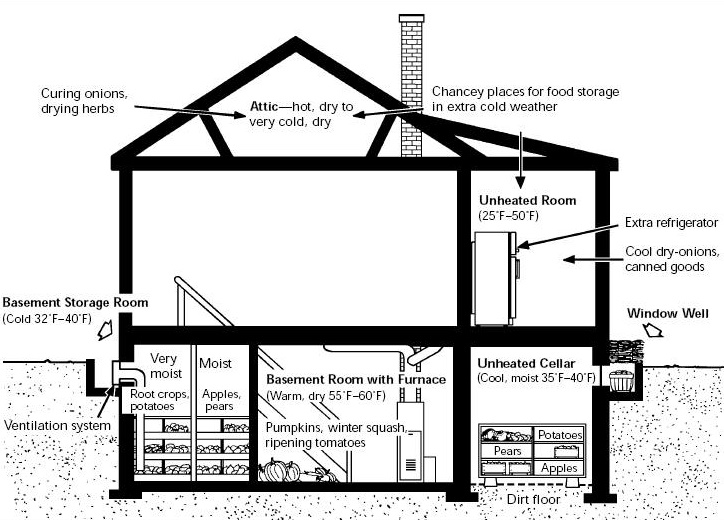
Figure 5. Areas in a house that could be used for storage.
Potatoes
Pears
Apples
Ventilation system
Dirt floor
Unheated Cellar
(Cool, moist 35°F-40°F)
Pumpkins, winter squash,
ripening tomatoes
Basement Room with Furnace
Apples, (Warm, dry 55°F-60°F)
pears
Root crops,
potatoes
Very Moist
moist
Basement Storage Room
(Cold 32°F-40°F)
Window WellCool dry-onions,
canned goods
Extra refrigerator
Unheated Room
(25°F-50°F)
Chancey places for food storage
Attic; hot, dry to in extra cold weather
very cold, dry
Curing onions,
drying herbs
http://cru.cahe.wsu.edu/CEPublications/eb1326/eb1326.pdf
Other references:
http://www.uga.edu/nchfp/how/store/csu_storage.pdf
http://www.uga.edu/nchfp/how/store/ksu_cupboard.pdf
Summary - Cost of Making Homemade Marmalade - makes 10 jars of 8 oz each* |
||||
| Item | Quantity | Cost in 2026</ | Source | Subtotal |
| Oranges | 8 medium or large sized | $2.00 | Grocery store | $2.00 |
| Lemons | 2 | $1.00 | Grocery Store | $1.00 |
| Canning jars (8 oz size), includes lids and rings | 10 jars | $11/dozen 8 oz jars or $0.92/jar12.00 |
Grocery stores (Publix, Kroger, Safeway, etc.) | $5.50 |
| Sugar | 4 cups | $2.00 | Grocery stores (Publix, Kroger, Safeway, etc.) | $2.00 |
| Pectin (low sugar, dry) | 1 and a third boxes | $2.00 per box | Grocery stores (Publix, Kroger, Safeway, etc.) | $2.70 |
| Total | $13.20 total or about $1.32 per jar |
|||
|
* - This assumes you already have the pots, pans, ladles,, and reusable equipment. Note that you can reuse the jars! Many products are sold in jars that will take the lids and rings for canning. For example, Classico Spaghetti sauce is in quart sized jars that work with Ball and Kerr lids and rings. Note that the Classico's manufacturer does not recommend reuse of their jars: see what they have to say on this page: |
||||
Can't find the equipment? We ship to all 50 states! Use our Feedback form!
Answers to Common Questions
- Why should cooked marmalade be made in small batches?
If a larger quantity of juice is used, it will be necessary to boil it longer thus causing loss of flavor, darkening of the maramalade, and toughening of the finished product. It really doesn't work. Trust me; I've tried many times! - Should marmalade be boiled slowly or rapidly?
It should be boiled rapidly, since long, slow boiling destroys the pectin in the fruit juice. - What do I do if there's mold on my marmalade?
Discard jams and jellies with mold on them. The mold could be producing a mycotoxin (poisonous substance that can make you sick). USDA and microbiologists recommend against scooping out the mold and using the remaining jam or marmalade. - Why did my marmalade ferment, and what do I do?
Jellied fruit products may ferment because of yeast growth. This can occur if the product is improperly processed and sealed, or if the sugar content is low. Fermented fruit products have a disagreeable taste. Discard them. - What happens if my jam or marmalade doesn't gel?
Remaking cooked runny jam or marmalade instructions can be found on the U.Ga. website. Directions about remaking uncooked jams or jellies can be found in a CES Publication from Ohio State University.
If you want to learn how NOT to make marmalade, read this entertaining account from this Australian woman who is either incredibly cheap or a slow learner... but either way, it's a funny story!
And if our recipe is too EASY for you and you would like a much more complicated approach that will take about 4 hours to complete, try Delia Smith's (a cook who is famous in the UK) orange marmalade recipe!
Canning Books, Supplies and Accessories
These are my favorite essential canning tools, books and supplies. I've been using many of these for over 50 years of canning! The ones below on this page are just the sampling of. my preferred tools. but you can find much more detailed and extensive selections on the pages that are linked below.
- Vacuum Foodsealers for freezing, dried foods, and refrigerated foods - the FoodSaver line
- Selecting a KitchenAid mixer and attachments for home canning
- Steam Juicers
- Strainers, pit removers, seed-skin-stem removers, jelly strainers, etc. All types, makes and prices (from $19 to $350)
- Cherry pitters reviews, prices and ordering
- Food dehydrators - easy and fast to dry your own fruits, veggies, sun-dried tomatoes, etc.
The All New Ball Book Of Canning And Preserving: Over 350 of the Best Canned, Jammed, Pickled, and Preserved Recipes Paperback
This is THE book on canning! My grandmother used this book when I was a child.; It tells you in simple instructions how to can almost anything; complete with recipes for jam, jellies, pickles, sauces, canning vegetables, meats, etc.
If it can be canned, this book likely tells you how! Click on the link below for more information and / or to buy (no obligation to buy)The New Ball Blue Book of Canning and Preserving
Canning and Preserving for Dummies by Karen Ward
This is another popular canning book. Click here for more information, reviews, prices for Canning and Preserving For Dummies
Of course, you do not need to buy ANY canning book as I have about 500 canning, freezing, dehydrating and more recipes all online for free, just see Easy Home Canning Directions.
Home Canning Kits
Ball Enamel Water Bath Canners:

I have several canners, and my favorite is the stainless steel one at right. It is easy to clean and seems like it will last forever. Mine is 10 years old and looks like new.
The black ones are the same type of standard canner that my grandmother used to make everything from applesauce to jams and jellies to tomato and spaghetti sauce.
This complete kit includes everything you need and lasts for years: the canner, jar rack, Jar grabber tongs, lid lifting wand, a plastic funnel, labels, bubble freer, It's much cheaper than buying the items separately. It's only missing the bible of canning, the Ball Blue Book.
You will never need anything else except jars & lids (and the jars are reusable)!
The complete list of canners is on these pages:
- Water bath canners - Good for acidic foods, like applesauce, pickles, salsa, jams, jellies, most fruits
- Pressure canners - needed for low and non-acidic foods, like canned vegetables (corn, green beans, etc), and meats
- Canners for glass top stoves if you have a glass or ceramic stove
- Canners for induction stovetops

Pressure Canners
If you plan on canning non-acidic foods and low acid foods that are not pickled - this means: meats, seafood, soups, green beans corn, most vegetables, etc., then you ABSOLUTELY must use a Pressure Canner.
Of course, you can use a pressure canner as a water bath canner as well - just don't seal it up, so it does not pressurize. This means a Pressure Canner is a 2-in-1 device. With it, you can can almost ANYTHING.
There are also other supplies, accessories, tools and more canners, of different styles, makes and prices, click here!
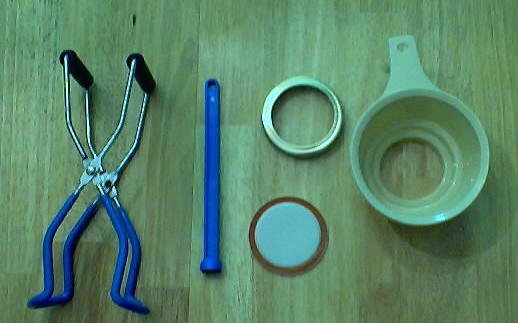
Basic Canning Accessories
From left to right:
- Jar lifting tongs to pick up hot jars
- Lid sanitizer / lifter - to remove lids from the pot of boiling water (sterilizing )
- Lids- disposable - you may only use them once
- Ring - holds the lids on the jar until after the jars cool - then you remove them, save them and reuse them
- Canning Jar funnel - to fill the jars
FREE Illustrated Canning, Freezing, Jam Instructions and Recipes
Don't spend money on books. that you don't need to. Almost everything you can find in some book sold online or in a store is on my website here for free. Start with theEasy Home Canning Directions below. That is a master list of canning directions which are all based upon the Ball Bblue book, the National Center for Home Food Preservation and other reputable lab tested recipes. Almost every recipe I present in addition to being lab tested com. is in a step by step format with photos for each step and complete. explanations. that tell you how to do it, where to get the supplies and pretty much everything you need to know. In addition, there almost always in a PDF format so you can print them out and use them while you cook.
[ Easy Home Canning Directions]
[FAQs - Answers to common questions and problems]
[Recommended books about home canning, jam making, drying and preserving!]


Looking for canning equipment and supplies?
Water bath canner with a jar rack
Pressure canners for gas, electric and induction stoves: Presto 23Qt or T-fal 22Qt
 Canning scoop (this one is PERFECT)
 Ball Blue book (most recent version)
Jars: 8oz canning jars for jams

Want to start your own Podcast, Blog, Vlog, etc? This
GoPro kit has EVERYTHING you need:
all accessories
Find Other types of farms:
Farm markets and roadside stands
Road trips and camping resources
Local Honey, apiaries, beekeepers
Consumer fraud and scams information
Home canning supplies at the best prices on the internet!
Maple Syrup Farms, sugarworks, maple syrup festivals
Environmental information and resources
Farms For Your Event for birthday parties, weddings, receptions, business meetings, retreats, etc.
Festivals - local fruit and vegetable festivals
Get the
most recent version of
the Ball Blue Book
Canning and preserving, making jams, salsa, sauces, pickles, etc is SO easy with our step by step directions! Just about all you need is a canner and canning jars!
