
Looking for Asian Murder Hornet: How to Recognize them and What to do in 2026? Scroll down this page and follow the links. And if you bring home some fruit or vegetables and want to can, freeze, make jam, salsa or pickles, see this page for simple, reliable, illustrated canning, freezing or preserving directions. There are plenty of other related resources, click on the resources dropdown above. If you are having a hard time finding canning lids, I've used these, and they're a great price & ship in 2 days.
If you have questions or feedback, please let me know! There are affiliate links on this page. Read our disclosure policy to learn more.
Asian Murder Hornet: How to Recognize them and What to do
 Asian
Murder Hornet: How to Recognize them and What to do
Asian
Murder Hornet: How to Recognize them and What to do
The Asian giant hornet (AGH) more commonly called the Asian Murder Hornet by the mass media, (scientific name Vespa mandarinia) is native to Asia but was first detected in Washington State in 2019 . It probably entered the U.S. through the illegal importation of live specimens for food and medicinal purposes. T
What is the threat of Asian Giant Hornets?
The AGH is a problem because
- it attacks honey bees and can cause the complete loss of colonies in the hives. This could endanger honey bees in the United States if it becomes established here. AGH earned its bad reputation from the way it hunts down honey bees and other insects, primarily during the late summer months when it seeks protein to feed its young.
- AGH is also a health concern for people with bee or wasp allergies.
- The Asian giant hornet is still rare in the U.S., so it is unlikely to murder you or U.S. bees, according to a Smithsonian entomologist.
Is the AGH a threat to humans?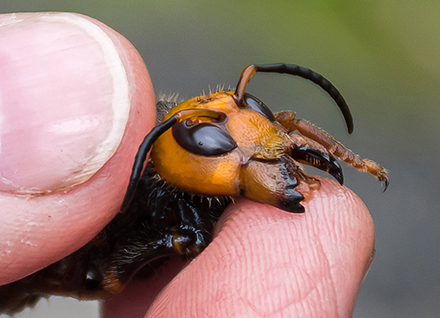
No, Americans do not need to panic about "Murder Hornets" (May 5, 2020) according to Smithsonian Institution. Smithsonian Magazine
The hornet's sting delivers a potent venom that can cause severe reactions in people who are allergic. In some cases, death, in some people who are allergic to bee stings. However, attacks against humans are rare. Most likely when a human encounters a hornet nest (in the ground)
AGH sightings in the United States have been limited to two verified reports near Blaine, WA, in December 2019, and a single AGH specimen found and verified in May 2020 near Custer, WA.
Identifying Asian Murder Hornets (AMH)

An Agricultural Research Service (ARS) scientist in the Pacific Northwest has joined the hunt for the infamous Asian giant hornet (AGH)
There are several key points to know to distinguish the Asian Murder Hornet from the common hornets
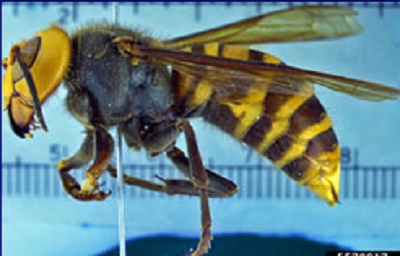
- At roughly 2 inches in length, this invasive species from Southeast Asia is the world's largest hornet. It's about twice the size of American hornets.
- It has distinctive markings: a large orange or yellow head and black-and-orange stripes across its body.
- Here's a video: Invasion! Asian Giant Hornets Have Arrived
Comparison: Asian Murder Hornets vs. common Hornets
The image below is from Texas A&M: Their youtube video about the AGH is excellent. The Asian giant hornet is often confused with the yellow-legged hornet (Vespa velutina), also known as the Asian hornet, an invasive species of major concern across Europe, including the UK.
The Asian Murder Hornet vs. Japanese Honeybees
The Japanese honey bee (Apis cerana japonica) has an effective strategy. When a hornet scout locates and approaches a Japanese honey bee hive, she emits specific pheromonal hunting signals. When the Japanese honey bees detect these pheromones, 100 or so gather near the entrance of the nest and set up a trap, keeping the entrance open. This permits the hornet to enter the hive. As the hornet enters, a mob of hundreds of bees surrounds it in a ball, completely covering it and preventing it from reacting effectively. The bees violently vibrate their flight muscles in much the same way as they do to heat the hive in cold conditions. This raises the temperature in the ball to the critical temperature of 46 °C (115 °F). In addition, the exertions of the honey bees raise the level of carbon dioxide (CO2) in the ball. At that concentration of CO2, they can tolerate up to 50 °C (122 °F), but the hornet cannot survive the combination of high temperature and high carbon dioxide level.[35][36] Some honey bees do die along with the intruder, much as happens when they attack other intruders with their stings, but by killing the hornet scout, they prevent it from summoning reinforcements that would wipe out the entire colony.
What can you do about Asian Murder Hornets?
At present, you should call a pest control service, and also report sightings below.
Pest control companies apply poisons or fires at night, which is an effective way of exterminating a colony. The most difficult part about this tactic is finding the subterranean nests.
Beekeepers use traps.
Bait traps are placed in apiaries. The system consists of multiple compartments that direct the hornet into a one-sided hole which is difficult to return through once it is in the cul-de-sac compartment, an area located at the top of the box which honey bees can escape from through a mesh opening, but wasps cannot due to their large size. Baits used to attract the hornets include a diluted millet jelly solution or a crude sugar solution with a mixture of intoxicants, vinegar, or fruit essence.
The trap is attached to the front of beehives. The effectiveness
of the trap is determined by its ability to capture hornets while
allowing honey bees to escape easily. The hornet enters the trap and
catches a bee. When it tries to fly back through the entrance of the
hive, it hits the front of the trap. The hornet flies upwards to
escape and enters the capture chamber, where the hornets are left to
die. Some hornets find a way to escape the trap through the front,
so these traps can be very inefficient
Reporting Asian Murder Hornets
See below to report any invasive species in your country.
In the United States
Reporting invasive species on your property
A: If you find invasive species on your property, it is up to you to decide what to do. You can leave them alone, or you might want to try and eradicate or control them. This may or may not be possible depending on the extent of the problem and whether your neighbors all around you have the species on their land as well. If you have a significant amount of property infested with invasives and would like to find out whether invasive species can be eradicated or habitats on your property can be restored, all of the sources in the question above may be of help. In addition, there are many Service programs and other government programs that could be of assistance. To find out more about these programs, please visit the Grants page of the Invasive Species Web Portal's Partnerships Page.
Where to report an invasive species on public land
A: If you are in a National or State Park, National Wildlife Refuge, or other piece of public land and you think you may have discovered a new invasive species, you should contact the closest park or refuge office and see if they are aware of the invasive species.
If you think you have found an aquatic invasive species, you should try and alert the local office as mentioned above, but there are two other ways you can report the discovery.
- To report an aquatic invasive species by phone, the U.S. Fish and Wildlife Service and the U.S. Geological Survey maintain an ANS Hotline at 800-STOP-ANS (877-786-7267).
- To report an aquatic invasive species online, please follow this link to the USGS Nonindigenous Aquatic Species Sighting Report Form.
Also to get a list of the species that are considered invasive in your area, contact your State Department of Natural Resources.
Reporting in the United Kingdom
Anywhere in the UK
In the UK, If you suspect you have seen an Asian hornet you should report this using the iPhone and Android app 'Asian Hornet Watch' or by using our online report form. Alternatively, e-mail alertnonnative@ceh.ac.uk.
GB Invasive Non-native Species Strategy was developed to meet the challenge posed by invasive non-native species in Great Britain. This website provides tools and information for those working to support the strategy. Where to send your records You can record any non-native species online through iRecord (external link). Please include a photograph of your sighting if you have one to help with identification.
Scotland
Record a sighting of a non-native species
- Take a photo - or write down a detailed description.
- Identify the location - ideally to within 100m of the sighting of the non-native species.
- Note the date and roughly how many (or how much) of the non-native species you saw.
Report a priority non-native species
'Prevention priority species' are non-native species that aren't yet established in Scotland, but are known to be highly invasive and are likely to arrive here soon. View the latest species alerts on the NNSS website.
By law, you must report a sighting on your land of:
- muntjac deer
- coypu
- musk rat
- exotic rabbit (i.e. not European rabbit)
You should report either type of sighting above promptly to Scotland's Environmental and Rural Services (SEARS).
Telephone: 0845 2 302 050
Email: info@sears.scotland.gov.uk
Report other non-native species
Records of other non-native species can help us to better understand species distribution and thus support better management.
In particular, be sure to report sightings of non-native species of concern in Scotland.
You can submit your records of species of concern:
- by completing the INNS reporting form
- by contacting SEARS on the phone number or email address above.
An expert will verify your sighting. Including a good quality photo or description will speed up this process. You may be asked for more details about the sighting.
All records will be made publicly available via NBN Atlas Scotland.
Related
References
- Takes On the Asian Giant Hornet (Jun 8, 2020)
- No, Americans Do Not Need to Panic About "Murder Hornets" (May 5, 2020)
- Pest Tracker - Survey Status of Asian Giant Hornet USDA. Cooperative Agricultural Pest Survey. National Agricultural Pest Information System.


Looking for canning equipment and supplies?
Water bath canner with a jar rack
Pressure canners for gas, electric and induction stoves: Presto 23Qt or T-fal 22Qt
 Canning scoop (this one is PERFECT)
 Ball Blue book (most recent version)
Jars: 8oz canning jars for jams

Want to start your own Podcast, Blog, Vlog, etc? This
GoPro kit has EVERYTHING you need:
all accessories
Find Other types of farms:
Farm markets and roadside stands
Road trips and camping resources
Local Honey, apiaries, beekeepers
Consumer fraud and scams information
Home canning supplies at the best prices on the internet!
Maple Syrup Farms, sugarworks, maple syrup festivals
Environmental information and resources
Farms For Your Event for birthday parties, weddings, receptions, business meetings, retreats, etc.
Festivals - local fruit and vegetable festivals
Get the
most recent version of
the Ball Blue Book
Canning and preserving, making jams, salsa, sauces, pickles, etc is SO easy with our step by step directions! Just about all you need is a canner and canning jars!
