
Looking for California Cottage Food Laws and Regulations: How to sell your homemade foods in California in 2026? Scroll down this page and follow the links. And if you bring home some fruit or vegetables and want to can, freeze, make jam, salsa or pickles, see this page for simple, reliable, illustrated canning, freezing or preserving directions. There are plenty of other related resources, click on the resources dropdown above. If you are having a hard time finding canning lids, I've used these, and they're a great price & ship in 2 days.
If you have questions or feedback, please let me know! There are affiliate links on this page. Read our disclosure policy to learn more.
California Cottage Food Laws and Regulations: How to sell your homemade foods in California
California Retail Food Laws, Regulations and Facts
Retail food businesses, that fall outside the "Cottage Food Operations" exemptions and rules are regulated under the California Retail Food Code (CRFC), which is under the California Health and Safety Code.
Retail food businesses, that fall outside the "Cottage Food Operations"
exemptions and rules, are regulated under the California Retail
Food Code contains the structural, equipment, and operational requirements for
all California retail food facilities. Provisions of the California Retail Food
Code are primarily enforced by 62 local environmental health regulatory
agencies. The California Department of Public Health, Food and Drug Branch,
plays a supporting role in the enforcement of the California Retail Food Code by
providing technical expertise to evaluate processes and procedures and to answer
technical and legal inquires for local agencies, industry and consumers.
General steps
Of course there are general steps required to start ANY type of business (you can see them further down the page here) But let's look at food-related requirements first.
When is a Health Permit Required?
Any storing, preparing, serving, manufacturing, packaging, transporting,
salvaging, or handling food for dispensing or sale directly to the consumer
requires a health permit. The health permit has an annual fee based on the type
of business and the size of the facility.
What are the details of your business?
Are you planning on a wholesale or retail operation? Will you be in a building,
or will you be mobile? How large is the facility? What are you planning on
selling? Are you catering? Are you processing? Each answer to these questions
help to determine the specific type of permit required.
- Retail vs. Wholesale:
"Retail" means the storing, preparing, serving, manufacturing, packaging, transporting, salvaging, or handling food for dispensing or sale directly to the consumer -- This office regulates retail facilities. "Wholesale" is the sale of food in quantity especially for resale by a retailer - The California Department of Public Health, Food & Drug Branch regulates wholesale facilities. Your business could be both, requiring a permit from this Department and another permit from the State. - Mobile Food Facilities:
There are different types of mobile food facilities, with different requirements. Please talk to an Environmental Health Specialist for review and approval. All mobile food facilities are required to operate out of an approved commissary. - Caterers:
See the "Catering Guidelines" handout for more information. All caterers are required to operate out of an approved commissary.
!!! Please be aware that it is unlawful to operate
any retail food business from your home !!!
What about Food Handler Certification?
State law mandates that certain food facilities are required to have at least
one owner or employee who has successfully passed an approved and accredited
food safety certification examination. Anyone involved in the preparation,
storage or serving of food must obtain a California Food Handler Card or a
Certified Food Protection Manager certificate. The certification is valid for
five years, and is issued to the individual who passes the exam. If that person
leaves employment, the facility must obtain another certified person within 60
days. The certified owner/employee is responsible for the safety of food
preparation and service, including employee education.
To obtain a CFH Card or a CFPM certificate, commercial kitchen owners and
employees must complete a safety-training course and pass an exam. The CFH
program requires three hours of training and the certificate is valid for three
years. The CFPM program requires eight hours of training and the certificate is
valid for five years. The California code for commercial kitchens also requires
prospective owners to obtain licenses depending on the kind of food they will be
serving.
What is Required in a Change of Ownership?
If you are the new owner of a retail business, you are required by this office
to apply for a new health permit. You will be asked to submit a health
permit application and pay an annual permit fee. As a new owner, you may be
required to upgrade the facility. (It is strongly suggested that you review the
facility file prior to closing the deal - there may be specific requirements
that demand correction upon new ownership).
If there are any changes to occur, the district EHS should be notified so the
proposed changes can be reviewed and approved. There may need to be a plan
review. Some examples of these changes are:
- Change of menu - May require additional equipment, such as a preparation sink.
- Changing the floor, walls, or ceiling - Only certain materials are approved.
- Installation of new equipment - All new or replaced equipment needs to be commercial-grade and be approved by this office before installation.
- Removing equipment - May not be approved if the equipment is needed for operation.
What is "Plan Review"?
Submission of plans is a requirement upon the proposal of a new or remodeled
retail food operation. The plans need to be reviewed and approved by this office
before any construction takes place.There is a plan review fee involved. Some
examples of when a plan review is required are:
- A food facility is brand-new or is being remodeled -- Complete plans shall be submitted to this office for review and approval prior to any construction. (Other agencies, such as the Building Department, may also be involved). See the "Plan Check Guide" handout for further details.
- An individual is proposing a new retail food operation (e.g., catering).
- There are extensive changes in an existing facility, operation, or menu.
Other requirements
Get a Business License
Another of the important commercial kitchen regulations California is that you must obtain a business license from the city, register your business name with the Secretary of State's Office, obtain a federal tax ID number from the IRS, and apply to the California State Board of Equalization for a sales tax license. While this is a California code that applies to all businesses, the sales tax is specific to businesses that will sell products and services for direct pay.
Learn Food Safety Practices
You obviously need to ensure that the food you serve to patrons is safe. Unless you like being the subject of lawsuits and prison. To do this you must comply with the regulations established by the U.S. Food Safety and Inspection Services. These are specific guidelines for caterers, box lunch delivery and kiosk operators, food trucks, and commercial kitchens. CDPH food safety inspectors use these guidelines when they inspect commercial kitchens. Typical food safety issues are about making sure your food is prepared and stored at the appropriate temperature, and that food is check at appropriate intervals to determine whether it is still safe and fresh.
Safety Inspections
The commercial kitchens are also subject to frequent (and usually unannounced) inspections conducted by officials at CDPH. They examine cooking surfaces, cooking equipment, floors, storage areas, and refrigeration. Violations result in fines or even suspension until the violation is corrected.
Fire Marshals also inspect for hazards related to grease, flames, electrical wiring, faulty smoke detectors, faulty fire extinguishers, or the lack of fire extinguishers.
Code compliance
Your kitchen's appliances and the plumbing system must comply with the Uniform Mechanical Code. Your county may also require that your facility complies with energy-saving regulations and green initiatives.
General Steps for starting a business
When starting a new business, there are many important decisions to make and many rules and procedures that must be addressed. While there is no single source for all filing requirements, the following steps have been developed to assist you in starting your business.
Step 1
It is helpful to begin with a business plan. A business plan is a blueprint of every aspect of your business. Sales, Marketing, Advertising, Promotion and Location are just some of the categories to consider when creating a plan. Go to the U.S. Small Business Administration website to find a tutorial on how to create a business plan.
Step 2
If you would like help deciding on a location for your business, contact the California Business Investment Services unit of the Governor's Office of Economic Development (GO-Biz). The California Business Investment Services unit provides tailored site selection services for businesses, real-estate executives, and site selection consultants.
Step 3
Choose a business structure. Select a business entity type from the following list for a brief overview of the principal types of legal business structures available in California. Private legal and tax advisors should be consulted before making a determination as to the type of business entity to form.
- Corporation
- Limited Liability Company
- Limited Partnership
- General Partnership
- Limited Liability Partnership
- Sole Proprietorship
Step 4
Your next step will be to file your tax and employer identification documents.
Step 5
Most businesses require licenses or permits in order to operate. Please click on each of the resources below to determine if your business requires any licenses or permits.
References
Fact Sheets
Online Food Safety Training
Regulations and Statutes
California Retail Food Code (PDF)
Good Manufacturing Practices for the Food Industry, Resource Document (PDF)
Food Recalls: Essentials for Action, Resource Document (PDF)
Good Manufacturing Practices for Food (PDF)
Sherman Food, Drug, and Cosmetic Law (PDF)
-
Good Manufacturing Practices for the Food Industry, Resource Document (PDF)
-
Food Recalls: Essentials for Action, Resource Document (PDF)
Certificates and Licenses
Guidelines
Guidelines
California Food Programs
Certificates and Licenses
California Food Related Agencies
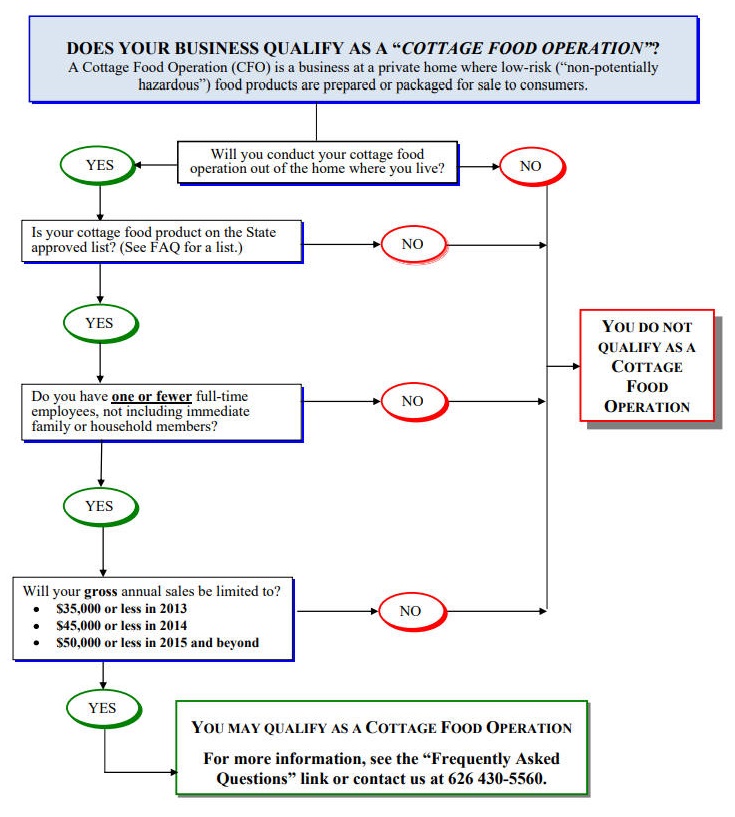
Frequently Asked Questions about the California Homemade Food Act in
Recommendations:
Get the Servsafe and CPFM Study Guide for Food Manager Certification in Paperback
And get the ServSafe Food Handler Guide
Beyond the requirements, common sense, good practices and reducing liability suggests you should do the following.
Training
Testing of pH
It's best to use a pH meter, properly calibrated on the day
used. I use this one, which is reliable and inexpensive.
And this pH meter is really good, but isn't always available.
Short-range paper
pH test strips, commonly known as litmus paper, may be used
instead, if the product normally has a pH of 4.0 or lower and the
paper's range includes a pH of 4.6.
Record-keeping is suggested
Keep a written record of every batch of product made for sale, including:
- Recipe, including procedures and ingredients
- Amount canned and sold
- Canning date
- Sale dates and locations
- Gross sales receipts
- Results of any pH test
Sanitation
Although inspections are not required, you should consider doing the following:
- Use clean equipment that has been effectively sanitized prior to use
- Clean work surfaces and then sanitize with bleach water before and after use
- Keep ingredients separate from other unprocessed foods
- Keep household pets out of the work area
- Keep walls and floors clean
- Have adequate lighting
- Keep window and door screens in good repair to keep insects out
- Wash hands frequently while working
- Consider annual testing of water if using a private well
More resources:
- PowerPoint of California Cottage Food Law
- Register or get permitted by local Environmental Health agency
- Operating Your Cottage Foods Business - guidance and resources for starting and operating your cottage food operation.
- Types of Cottage Foods - Information and handbooks for Cottage Food Production
- Cottage Food Operations (PDF)
- Cottage Food Approved Food List (PDF)
- Frequently Asked Questions (PDF) or in Espanol ]
- Registration and Permit Requirements (PDF)
- California Homemade Food Act
- Statutory Provisions Related to Sanitation (PDF)
- Cottage Food Operator Training (PDF)
Los Angeles County and Other counties have good resources: These are PDF files which you can view online, download or print
- Cottage Food Operations Guide
- Does your business qualify as a Cottage Food Operation?
- Frequently Asked Questions about the California Homemade Food Act in [ English | Espanol ]
- Complete text for AB 1616: the California Homemade Food Act
- Labeling Requirements for Cottage Food Products
- Food Labels - Information for California Food Processors
- Cottage Food Operation Official Inspection Report
- Los Angeles County Cottage Food Operators [ Class A | Class B ]
Questions? Contact Information:
PO Box 997377MS 0500
Sacramento, CA 95899-7377
For General Public Information:
(916) 558-1784


Looking for canning equipment and supplies?
Water bath canner with a jar rack
Pressure canners for gas, electric and induction stoves: Presto 23Qt or T-fal 22Qt
 Canning scoop (this one is PERFECT)
 Ball Blue book (most recent version)
Jars: 8oz canning jars for jams

Want to start your own Podcast, Blog, Vlog, etc? This
GoPro kit has EVERYTHING you need:
all accessories
Find Other types of farms:
Farm markets and roadside stands
Road trips and camping resources
Local Honey, apiaries, beekeepers
Consumer fraud and scams information
Home canning supplies at the best prices on the internet!
Maple Syrup Farms, sugarworks, maple syrup festivals
Environmental information and resources
Farms For Your Event for birthday parties, weddings, receptions, business meetings, retreats, etc.
Festivals - local fruit and vegetable festivals
Get the
most recent version of
the Ball Blue Book
Canning and preserving, making jams, salsa, sauces, pickles, etc is SO easy with our step by step directions! Just about all you need is a canner and canning jars!
