
Looking for Arizona Cottage Food Laws and Regulations: How to sell your homemade foods in Arizona in 2026? Scroll down this page and follow the links. And if you bring home some fruit or vegetables and want to can, freeze, make jam, salsa or pickles, see this page for simple, reliable, illustrated canning, freezing or preserving directions. There are plenty of other related resources, click on the resources dropdown above. If you are having a hard time finding canning lids, I've used these, and they're a great price & ship in 2 days.
If you have questions or feedback, please let me know! There are affiliate links on this page. Read our disclosure policy to learn more.
Arizona Cottage Food Laws and Regulations: How to sell your homemade foods in Arizona
Arizona Cottage Food Laws, Regulations and Facts
Date of the enactment of the Arizona cottage food law: July 2011.
The new 2025 rules are applicable to all Cottage Food registrants. New and existing Cottage Food
registrants and future entrepreneurs should review the rules as some have changed since 2011. See
Cottage Food , R9-8-101.02
A.R.S. 36-931 Article 2 Cottage Food Products
36-931 Definitions
36-932 Labeling; food
handler certification; sale and delivery requirements
36-933 Applicability of article; rules; enforcement
The new rules are effective as of February 4, 2025. Please review the rules here, Cottage Food ,
R9-8-101.02.
It limits producers to just baked goods, confections and some jams, jellies, preserves, fruit butters, but there is no sales limit, and getting started is easy.
Which foods are subject to the Arizona Cottage Food law?
The law limits cottage foods to baked and confectionary goods and fruit jam and jelly. The state has an approved foods page here.
Examples include:
- Breads (Sweet breads and Bread)
- Bagels
- Biscuits
- Brittles
- Brownies and fudge
- Cakes (Cakes with hard icings or frostings)
- Candies
- Caramel corn
- Chocolate Fudge
- Chocolate-covered fruit
- Chocolate-covered items
- Cookies
- Crackers
- Doughnuts
- Dry pasta
- Dry spice mixes
- Fruit jams and jellies (there are special requirements for jams and jellies, see this page)
- Granola
- Honey
- Kettle corn
- Mixes Spices & Seasonings
- Muffins
- Pastries
- Pies (Fruit pies with fruit and sugar fillings)
- Popcorn
- Pretzels
- Pumpkin breads, cakes, cookies, muffins, and rolls
- Roasted Coffee Beans
- Roasted nuts
- Rolls
- Scones
- Tarts
- Toffee
- Tortillas
- Truffles
- Waffle cones
Please note that although eggs, milk, and other dairy products are considered potentially hazardous, they are allowed to be used as ingredients within the dough or batter of baked goods (such as breads, cookies, and cakes).
Prohibited foods
Everything other than baked goods and confections . For example, jams and jellies, are prohibited. Why is some food considered potentially hazardous? Food is often considered potentially hazardous because it contains moisture, usually regarded as a water activity greater than 0.85, contains protein, or is neutral to slightly acidic, typically a pH of 4.36 and 7.5.
Some examples of prohibited foods (by no means is this all-inclusive)
- Any foods that require refrigeration
- Acidified foods
- Beverages (coffee, soda, juice, etc.)
- Butter and spreads and Nut Butters
- Buttercream frostings
- Cakes with custard fillings
- Cheesecakes
- Custards
- Dehydrated Fruits and Vegetables
- Fillings, Frostings, and Icings (including ganache) that do not follow Arizona's Frosting Guidance
- Fruit butters
- Ketchup
- Meat, fish, shellfish products
- Meat jerky
- Meringues, Cream or Custard Pie
- Mustards
- Nut butters
- Oils and Vinegars
- Pecan Pie
- Perishable baked goods
- Pet foods or pet treats
- Pickled and Fermented Foods
- Potato chips
- Preserves
- Pumpkin cheesecake
- Pumpkin Pie,
- Puddings
- Reduced oxygen packaged products
- Salsas
- Sauces
- Sweet Potato Pie,
- Syrups
- Tamales
- Custards, puddings, cupcakes or cakes with custard or cream fillings, meringues, cheese cakes, cream or custard pies, and other desserts with high pH and water activity are not allowed.
If the item that you want to make is not on this list, , please contact Arizona State to see if it is non-potentially hazardous.
- Phone: (602) 364-3118
- Email: HomeBakedGoods@azdhs.gov
AZ used to have a list of previously approved foods, but now it is only a list of all people where were given approvals, sorted by location. There is not a lot of use to that page, so I would refer you instead to the AZ approved foods page instead.
If your food product does not meet the definition of a Cottage Food:
Don't give up. You may still be able to make and sell it commercially, through a startup approach. If the item that you want to make is NOT on the approved list it is considered a "potentially hazardous good", and you would need to obtain a permit from your county environmental services office and produce the food products in a licensed and inspected commercial kitchen.
First, you may be able to rent space in a local licensed commercial kitchen.
Second, if that doesn't work, you may be able to get a co-packer to make the food for you.
If you really did want to get your kitchen licensed, you would need to contact your county's environmental health department to obtain the necessary license.
Definitions:
- Kitchen - in your home; all Cottage Food items prepared by a registrant of the program must be prepared at the registrant's home, you may not make themn in a kitchen outside of your home.
Licensing
- Registration is required (it may be done online (easy and free),
- Most producers will also need to get a food handler card.
Summary: To register for the program,
- Obtain a food handler's card, if offered in the county in which you live; and next
- omplete the first-time Arizona online cottage foods new registration form here.or the RENEWAL Arizona online cottage foods registration form. The Road Map is designed to allow you to figure out everything you need to make your registration as smooth and easy as possible, shortening the turnaround time.
Details:
Arizona residents are required by ARS 36-136(H)(4)(g) to register to be authorized to produce products for commercial purposes. Registrants can also choose to sign up for email updates from the program which will include food safety information, product recalls, and healthy baked good recipes from the Arizona Department of Health Services.
To become a registered home baker, you need to obtain a food handler card or training certificate, as required by your county. Some counties issue a county-specific food handler card, some only require you to take a food handler training course, and others have no food handler training requirements at all. If your county does not require food handler training, you are still strongly encouraged to take a food handler training course. Here is a list of online training certificate programs accredited by the American National Standards Institute (ANSI).
Other licenses:
See your county and municipality for:
- Assessor's Office (for questions about business-related property taxes)
- Planning & Zoning Office (for questions about zoning restrictions on home-based businesses)
- City Clerk (for questions on local business license requirements)
- You may also want to contact your insurance company to determine the impact (if any) of a home-based business on homeowner's liability. In general, you will at least need to add an "Umbrella policy"
Training and Food Handler Cards
Under ARS 36-136 (H)(4)(g), you are required to obtain a food handler's card or certificate, as required by your county. This food handler training requirement needs to be fulfilled before preparing any products under the Home Baked and Confectionery Goods Program.
Some counties issue a county-specific food handler card and some only require you to take a food handler training course online.
If your county does not require food handler training, you are still strongly encouraged to take a food handler training course.
See this page for a list of online training certificate programs accredited by the American National Standards Institute (ANSI Food Handler Training Certificate Programs.
 Labeling requirements
(changed on July 1, 2019)
Labeling requirements
(changed on July 1, 2019)
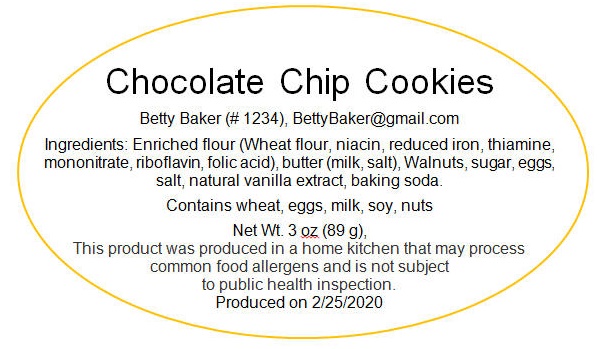
Cottage Food Production Operations must label all of their food products properly, which includes specified information on the label of each unit of home baked good or Confectionery item when it is offered for sale:
- The name and registration number of the food preparer (Registration numbers began July 1, 2019, Home address is no longer required on the label.)
- A list of all the ingredients in the product
- The product's production date
- The following statement: "This product was produced in a home kitchen that may process common food allergens and is not subject to public health inspection."
- If applicable, a statement that the product was made in a facility for individuals with developmental disabilities.
More detailed Arizona Label requirements and a downloadable label format to customize can be found here. Depending on the size of your business, your label must comply with Federal label regulations and with the new nutritional labeling law. You can download a copy of the FDA Food Labeling Guide here it s an illustrated booklet that should answer all your questions.
Where may Cottage Food Production Operations sell the food products?
Cottage Food Products may not be sold across state lines. Aside from that, you may can sell at any venue within the state, grocery stores, registered farm markets, church bake sales, schools, registered farmers markets, and sold and/or used in preparing food in a restaurant.
To sell at a local store, you must:
- Take a food handler training course and then register online with the Cottage Food Program.
- After you receive your certificate of registration through your email, follow the guidelines for developing a package label (see labeling below), and start making your product. As long as your product is labeled appropriately, it can be sold in a retail food establishment within Arizona.
- The location that you want to sell at must
1) allow you to sell your goods in their retail food establishment and
2) ensure that the customer is notified that the product was made in a private home.
Other requirements
See this State of Arizona website for all the other details
Once you have your food handler training certificate/card and your certificate of registration, you may begin selling your goods. However, we do suggest that you contact the following people on the county and municipality level:
- Assessor's Office (for questions about business-related property taxes)
- Planning & Zoning Office (for questions about zoning restrictions on home-based businesses)
- City Clerk (for questions on local business license requirements)
You may also want to contact your insurance company to determine the impact (if any) of a home-based business on homeowner's liability.
Recommendations:
Get the Servsafe and CPFM Study Guide for Food Manager Certification in Paperback
And get the ServSafe Food Handler Guide
Beyond the requirements, common sense, good practices and reducing liability suggests you should do the following.
Training
Testing of pH
It's best to use a pH meter, properly calibrated on the day
used. I use this one, which is reliable and inexpensive.
And this pH meter is really good, but isn't always available.
Short-range paper
pH test strips, commonly known as litmus paper, may be used
instead, if the product normally has a pH of 4.0 or lower and the
paper's range includes a pH of 4.6.
Record-keeping is suggested
Keep a written record of every batch of product made for sale, including:
- Recipe, including procedures and ingredients
- Amount canned and sold
- Canning date
- Sale dates and locations
- Gross sales receipts
- Results of any pH test
Sanitation
Although inspections are not required, you should consider doing the following:
- Use clean equipment that has been effectively sanitized prior to use
- Clean work surfaces and then sanitize with bleach water before and after use
- Keep ingredients separate from other unprocessed foods
- Keep household pets out of the work area
- Keep walls and floors clean
- Have adequate lighting
- Keep window and door screens in good repair to keep insects out
- Wash hands frequently while working
- Consider annual testing of water if using a private well
Best Practices
- Allergens: Most state home baking
acts require an "ingredient statement" and/or an "allergen
listing" on the label of the bakery item for sale; but if your
state does not, you should anyway. The eight major food
allergens are
- milk,
- eggs,
- fish,
- crustacean shellfish,
- tree nuts,
- peanuts,
- wheat and
- soybean.
- Cross-allergenicity: There are also ingredients available, even flours, that can cause a cross-allergenicity. The American Academy of Allergy Asthma & Immunology explains cross-allergenicity as an allergic reaction when proteins in one substance are similar to the proteins found in another substance. For example, consumption of lupine flour may trigger an allergic reaction to peanuts, and cricket flour may trigger an allergic reaction to shellfish. Again, providing such information might be a beneficial marketing tool and help keep potential consumers safe.
- The 2 Hour/4 Hour Rule - Anyone
wishing to make and sell refrigerated bakery items should
remember to follow the "2 Hour/4 Hour Rule." This is a system
that can be implemented when potentially hazardous foods are out
of temperature control (temperatures greater than 45 degrees
Fahrenheit) during preparation, serving or display for sale. The
rule guidelines are as follows:
- If a potentially hazardous food has been out of temperature control for 2 hours or less, then it may continue to be used or be placed back in the refrigerator.
- If a potentially hazardous food has been out of temperature control for more than 2 hours but less than 4 hours, it needs to be used quickly or discarded.
- If a potentially hazardous food has been out of temperature control for more than 4 hours, it must be discarded.
More resources:
- Arizona Requirements for Jams and Jellies
- Arizona Frequently Asked Questions (FAQs)
- Arizona Label requirements and a downloadable label format to customize can be found here.
-
Arizona's cottage food website links:
- Program Registration Register for the Cottage Food Program to prepare homemade food for commercial use.
- Food Handler Training Obtain required food handler training online or in your area prior to registration.
- Cottage Food Guidance Learn more about how to properly prepare your homemade food products.
- Approved Food Products Determine if your product is approved for production under the Cottage Food Program.
- Food Testing Have your homemade food tested at a food safety lab for pH and water activity.
- Labeling Requirements Learn what information is required to be on your product label.
- Special Processes Learn more about freeze-dried homemade foods under the Cottage Food Program.
- Frostings & Seasonal Foods Find out what frostings, icings, and fillings you can use on your desserts.
- Jams and Jellies See what types of canned products you are permitted to make.
- Frequently Asked Questions (FAQs) Get answers to some of the most frequently asked questions.
- Complaints Report a complaint to the Cottage Foods Program
- Contact Us Contact the Cottage Foods Program.
- Click here for more information about this state's cottage food requirements.
- Many Arizona Cottage foods frequently asked questions and answers.
- Arizona has an informational video for home-based businesses.
- FDA Food labeling information.
-
Arizona state and local health department contact information.
- Good to know (not a requirement): Guidelines for Determining Metric Equivalents of Household Measures (October 1, 1993)
- Massachusetts has a Food Processors Resource Manual
that is a practical guide for specialty food and start-up food
processors published by the Massachusetts Department of
Agricultural Resources. The marketing and practical tips can be
very useful to a cottage food kitchen in any state.
The chapters are available online and as a downloadable document
pdf format
Introduction
Starting Out
Production
Residential Kitchens: Questions and Answers
Developing a Business Plan
Label and Product Regulations
Label Design
Promotion
Distribution and Sales
Trade Shows
Using the Internet for Marketing
Questions? Contact Information:
Office of Environmental Health
150 N. 18th Avenue, Suite 140
Phoenix, AZ 85007
(602) 364-3118
(602) 364-3146 Fax
Email: HomeBakedGoods@azdhs.gov
July 2025 Updated rules
R9-8-101.02. Cottage Food, February 28, 2025
A. An individual wanting to prepare a cottage FOOD product, as defined in A.R.S. § 36-931, for
commercial purposes and to be exempt from the requirements in all other Sections of this Article shall:
1. Complete a food handler training course from an accredited program that has been evaluated and listed
by an accrediting agency as conforming to national standards for organizations that certify individuals;
2. Submit an application for registration to the Department that includes:
a. The following information in a Department-provided format:
i. The individual’s name, address,
telephone number, and email address;
ii. The street address, city, county, and state of the home where
the cottage FOOD is prepared;
iii. Whether the home where the cottage FOOD is prepared is a facility for
developmentally disabled
individuals; and
iv. A description of each cottage FOOD prepared for
commercial purposes;
b. A copy of the individual’s active certificate of completion for the food handler
training course from the
accredited program in subsection (A)(1); and
c. A signed attestation, in a
Department-provided format, that the individual:
i. Has reviewed Department-provided information on FOOD
safety and safe FOOD handling practices;
ii. Will prepare and sell or offer for sale cottage FOOD to the
public only if the cottage FOOD meets the
requirements of A.R.S. Title 36, Chapter 8, Article 2, and this
Section;
iii. While preparing cottage FOOD for commercial purposes, will follow the safety guidance from
the food
handler’s training course required according to subsection (A)(1), as well as the Department
provided
information on FOOD safety and safe FOOD handling practices, including the requirements for the
safe
handling, processing, and storage of FOOD that is a TIME/TEMPERATURE CONTROL FOR SAFETYFOOD;
iv.
Will prepare the cottage FOOD in the home kitchen at the address provided in subsection (A)(2)(a)(ii),
asdefined in A.R.S. § 36-931(3);
v. Will make, package, and attach a legible label according to A.R.S. §
36-932;
vi. Will dispose of FOOD waste and kitchen waste in a safe and sanitary manner;
vii. Will
directly supervise and be responsible for the tasks undertaken by another individual who is not
registered with the Department and assisting in preparing cottage FOODS for commercial purposes, in
accordance with A.R.S. § 36932(C);
viii. If selling cottage FOOD products online, will advertise the sale
in accordance with A.R.S. § 36-932(B);
ix. Will sell, transport, and deliver cottage FOOD products
according to A.R.S. § 36-932(E);
x. Except as otherwise permitted by A.R.S. § 36-931(1)(b), will not make
cottage FOODS that are or that
contain alcoholic beverages, unpasteurized milk products, fish, shellfish
products, meat, meat by-products,
poultry, or poultry byproducts;
xi. Will not sell a cottage FOOD
product with the intent for the cottage FOOD product to be used as an
ingredient to make other products
sold at a retail establishment, as specified in A.R.S. § 36-932(F)(1);
xii. Will not prepare products
containing marijuana or marijuana products, as specified in A.R.S. § 36-
932(F)(2);
xiii. Will only
use an ingredient if the ingredient is from an approved source and allowed by law, as specified
in A.R.S.
§ 36-932(G);
xiv. Will not use the home kitchen, as defined in A.R.S. § 36-931(3), as a commissary for a
mobile food unit,
as specified in A.R.S. § 36-932(H);
xv. Will not store cottage FOOD products or FOOD
preparation equipment outside of the individual’s
home, in accordance with A.R.S. § 36-932(D)(2);
xvi.
Will not prepare cottage FOODS for commercial purposes if the individual’s certification according to
subsection (A)(3) and registration with the Department, according to subsection (A)(4) have expired;
xvii. Understands and acknowledges that the individual’s registration as a cottage FOOD preparer with the
Department does not exempt the individual or the FOOD or drink products that the individual prepares
and
sells or offers for sale from the requirements for brand inspections, animal health inspections, or any
FOOD inspections required by state or federal law or the requirements for the sale of milk, milk products,
raw milk, and raw milk products under A.R.S. § 3606 and that the individual may be subject to disciplinary
action by the agencies charged with enforcing those requirements should those requirements be violated;
and
xviii. Understands that noncompliance with the requirements in A.R.S. §§ 36-931 through 36-933 and
this
Section may result in suspension or revocation of registration, according to A.R.S. § 36-933(C), or
to civil
or criminal penalties;
3. Not prepare a cottage FOOD product for sale to a consumer, if the individual does not have a current
registration with the Department;
4. Maintain an active certification from a food handler training course from an accredited program that
has
been evaluated and listed by an accrediting agency as conforming to national standards for
organizations
that certify individual;
5. Renew the registration in subsection (A)(3) every three years;
6. Submit any change to the information or documents provided according to subsection (A)(2) to the
Department within 30 calendar days after the change; and
7. Display the cottage food preparer’s certificate of registration when selling cottage FOOD at a location other than from the home kitchen.
B. An individual is not exempt from all other requirements in this Article if the individual does not
maintain
both an active food handler’s certification, according to subsection (A)(4), and a current
registration as a
cottage food preparer with the Department, according to subsection (A)(5).
C. The registered cottage food preparer shall:
1.Prepare FOOD in the home kitchen of the registered cottage food preparer;
2. Only use ingredients from an approved source and allowed by law, as specified in A.R.S. § 36-932(G);
3. Package the food at the home with an attached label that meets the requirements in A.R.S. § 36-932,
including:
a. The name and registration number of the cottage food preparer registered with the Department;
b. A
list of all ingredients in the cottage FOOD;
c. The date the cottage FOOD was prepared;
d. The
statement required by A.R.S. § 36-932(A)(3): This product was produced in a home kitchen that may
come in
contact with common FOOD allergens and pet allergens and is not subject to public health
inspection;
e. The statement required by A.R.S. § 36-932(A)(5): To obtain additional information about cottage foods
or to report a foodborne illness, go to azdhs.gov/Cottagefood; and
f. If applicable, a statement that the
cottage FOOD was prepared in the home kitchen of a facility for
individuals with developmental
disabilities; and
4. Ensure that the packaging:
a. Is clean and sanitary, and secure; is appropriate for the consistency and temperature of the food; and
totally encloses the food; and
b. Contains a tamper-evident seal, which could be the label.
D. The registered cottage food preparer selling the cottage food:
1. Shall only offer cottage FOODS for sale and delivery in Arizona;
2. For cottage food products that are not Time/Temperature Control for Safety FOODS, may:
a. Sell and deliver directly to a consumer, or
b. Use a third-party food delivery platform for
delivery to a consumer;
3. If using a third-party delivery platform, shall utilize a third-party delivery platform that agrees
to comply
with A.R.S. § 36-932 (E)(2);
4. For cottage food products that are Time/Temperature Control for Safety FOODS or contain meat or
poultry products, shall ensure that the food:
a. Is delivered in person directly to the consumer;
b. Is not delivered by a third-party food delivery
platform;
c. Is maintained at the appropriate temperature during delivery and until provided to the
consumer;
d. Is transported to no more than one destination and for no longer than two hours in duration,
including
any time spent delayed in traffic; and
e. Is not sold to the public except at the initial
destination; and
5. If selling a cottage food product through a third-party vendor, such as inside a store or kiosk, shall ensure that:
a. The cottage food product is sold in a separate section of the store or on a display case separate from
non-homemade food items, and
b. The third-party vendor displays a sign that indicates that the cottage
food product is homemade and
exempt from state licensing and inspection.
E. If a cottage food product is offered for sale online, the registered cottage food preparer shall
provide a
prominent notification that includes all of the labeling information required in subsections
(C)(3)(a)
through (f).
F. The Department shall:
1. Process an application in subsection (A)(2) according to A.R.S. § 41-1073;
2. Issue a certificate
of registration if the application is in compliance with the requirements of this
Section;
3. Notify
the applicant in writing if additional information is required;
4. Consider the application withdrawn if
the Department does not receive a response to the notification in
subsection (F)(3) within 30 days after
the notification; and
5. Deny an application that is not in compliance with this Section.
G. The Department:
1. Shall notify the registered cottage food preparer in writing of:
a. Suspected noncompliance with
A.R.S. Title 36, Chapter 8, Article 1, or this Section; or
b. Receipt of a food safety complaint; and
2. May suspend or revoke the cottage food preparer’s registration for:
a. Noncompliance with A.R.S. Title
36, Chapter 8, Article 1, or this Section;
b. Receipt of a verified food safety complaint;
c. Impeding
the investigation, according to 9 A.A.C. 6, Article 2 or 3, of a reported foodborne illness; or
d. A
violation under A.R.S. § 36-601.
H. A registered cottage food preparer may appeal a suspension or revocation according to A.R.S. Title
41,
Chapter 6, Article 10.
The University of Arizona Food Product and Safety Lab offers food testing services to food producers. They can test any type of food
product for a variety of different analyses. Contact phone, (520) 318-7021.


Looking for canning equipment and supplies?
Water bath canner with a jar rack
Pressure canners for gas, electric and induction stoves: Presto 23Qt or T-fal 22Qt
 Canning scoop (this one is PERFECT)
 Ball Blue book (most recent version)
Jars: 8oz canning jars for jams

Want to start your own Podcast, Blog, Vlog, etc? This
GoPro kit has EVERYTHING you need:
all accessories
Find Other types of farms:
Farm markets and roadside stands
Road trips and camping resources
Local Honey, apiaries, beekeepers
Consumer fraud and scams information
Home canning supplies at the best prices on the internet!
Maple Syrup Farms, sugarworks, maple syrup festivals
Environmental information and resources
Farms For Your Event for birthday parties, weddings, receptions, business meetings, retreats, etc.
Festivals - local fruit and vegetable festivals
Get the
most recent version of
the Ball Blue Book
Canning and preserving, making jams, salsa, sauces, pickles, etc is SO easy with our step by step directions! Just about all you need is a canner and canning jars!
